Path
esser
Contact
Contact name or title
Reach an ESSER Specialist

Addressing Disrupted Learning

Addressing Disrupted Learning

Return to ESSER III Overview.

The American Rescue Plan stipulates that 20% of an LEA’s total ESSER III award must be reserved to address learning loss through the implementation of evidence-based interventions, such as summer learning or summer enrichment, extended day, comprehensive afterschool programs, or extended school year programs.

All activities and interventions funded through this required set aside must be evidence-based (see below), respond to students' academic, social, and emotional needs and address the disproportionate impact of COVID-19 on vulnerable student populations, including each major racial and ethnic group, children from low-income families, children with disabilities, English learners, gender, and migrant status, students experiencing homelessness, and children and youth in foster care.

  • Activities and interventions may include:
  • Summer learning or summer enrichment programs
  • Extended day programs
  • Comprehensive afterschool programs
  • Extended school year programs
  • Other strategies (which could be during the regular school day)

Evidence-Based

“Evidence-based” has the same definition as used in the Every Student Succeeds Act (ESSA) for programs such as Title I-A.

Our Evidence-Based Practices, Strategies, Programs and Intervention webpage for more information, training materials and resources – to include tools and external websites that may be used to identify evidence-based resources, programs, practices and interventions

Resources for 20% Setaside Funds


Search an LEA below to review their plan for addressing disrupted learning. Only LEAs whose ESSER III applications have been "approved" (not submitted) are featured here.
ESSER III

ESSER III

Important Note Regarding Late Liquidation:

The liquidation extension does not allow for additional time for spending ESSER funds. Late liquidation is only for:

  • LEAs who are not at high risk for FY25
  • Fulfilling 3rd party contracts for education services (eg: to provide tutoring until the end of the school year)
  • Already approved construction projects that have unforeseen delays
  • Products that have delayed delivery

Please submit your proposal by July 19th. Additional Liquidation Extension guidance will come out soon.

ESSER Liquidation Extension 2024

The Arizona Department of Education (ADE) has received funding through the American Rescue Plan (ARP) Act to provide new Elementary and Secondary School Emergency Relief (ESSER III) Fund grants to LEAs to support local recovery needs and efforts in response to COVID-19. 

You can contact our ESSER team anytime at [email protected] or Jessica Deery, 602-542-3068.

ESSER III - ADE setaside funds 

The Arizona Department of Education received an incredible 130+ submissions for ESSER III Set-Aside dollars. These applications were for the Arizona Department of Education’s discretionary funds from the third federal COVID-19 recovery act, the American Rescue Plan, and are distinct from the ESSER III funds available only to LEAs through grant applications that were due this month.  

Our team is reviewing submissions and plans to announce recipients by Spring 2022.

GREAT NEWS!  Unlike ESSER I, there will be a single completion report for ESSER II and a single completion report for ESSER III.  This will remove the burden of completing a second application and budget with unspent carry over funds. See information below:

ESSER Completion Reports

ESSER III - LEA Allocations

Ninety percent of Arizona’s total $2.5 billion ESSER III Fund award is required to be allocated to LEAs based on the proportionate share of Title I-A funds they received in SY20-21, totaling $2,323,888,827.30.

Additional funds were provided using ADE’s SEA Discretionary Activities Reserve to ensure all non-profit Non-Title I-A LEAs and CTED Entities receive an award of $570 per pupil, and to ensure all Title I-A LEAs receive an award of at least $570 per pupil.

In total, $2,372,250,366.22 has been allocated to LEAs through ESSER III.

LEAs applying for their ESSER III allocations should have submitted their application on February 1, 2022. This deadline was set by the US Department of Education.

ESSER III Allocations

How is ESSER III different from ESSER I and ESSER II?

ESSER III differs from the first two ESSER awards. It contains new requirements for LEAs. These include:

How do I apply to use my ESSER III Funds?

The ESSER III application for Title-I-A LEAs, Non-Title I-A LEAs and CTED Entities was due February 1, 2022. This deadline was established by the US Department of Education. 

ESSER III Allocations

  • Download the list of available ESSER III allocations:

ESSER III Allocations

What is the process for Non-Title I-A LEAs receiving small ESSER III awards ($50,000 or less):

  • Based on stakeholder feedback, small Non-Title I-A LEAs receiving an ESSER III allocation of $50,000 or less will be provided their award as a supplement to their existing ESSER II award. This will streamline the process for small Non-Title I-A LEAs to access and leverage these new funds, remove the need for small LEAs to complete a new application for ESSER III, and will also waive the new ESSER III LEA plan requirements. If a small LEA would rather access their ESSER III funds through the new ESSER III application process (with all the new ESSER IIII requirements) they may do so through sending a request to [email protected]

Webinars

Guidance

NEW:  Step by Step ESSER III Completion with narrative examples

Stakeholder Engagement Resource

ADE partnered with Achieve60AZ, College Success Arizona, Expect More Arizona and Arizona School Administrators to create and share a new resource to support LEAs to meet new ESSER III local stakeholder engagement requirements. 

What should ESSER III Funds be used for?

ESSER III – just like ESSER I & II funds - are highly flexible, and are designed to help address local recovery efforts relative to responding to COVID-19. ESSER III Funds can be used throughout the LEA, in all schools and in support of all students and staff.

Prior Approval -- Construction/HVAC Assurances - For District Schools 

Prior Approval -- Construction/HVAC Assurances - For Charter Schools

New 20% Set-Aside Requirements

The American Rescue Plan stipulates that 20% of an LEA’s total ESSER III award must be reserved to address learning loss through the implementation of evidence-based interventions, such as summer learning or summer enrichment, extended day, comprehensive afterschool programs, or extended school year programs.

2021-2022 ESSA Evidence Based Requirements and Resource Guidance for ESSER

School Support and Improvement Evidence Base Resources 

20% Set-Aside Data Review-Evidence of Efficacy/Improved Outcomes

ESSER III Monitoring Announcement-20% Set Aside Trainings

ESSER DATA CHART 20% Set-Aside EBIs

Measuring Outcomes for Evidence-Based Strategies, Intended Outcomes, and Success Indicators-REL West October Training 4.1.10


Learn More

ESSER III Revisions

Information on When to Complete a Revision, How to Complete a Revision, and Next Steps

ESSER III Revisions - PowerPoint 


Safe Return to In-Person Instruction Plan Requirements

All LEAs receiving ESSER III funds must develop and make publicly available on their website, a plan for the Safe Return to In-Person Instruction and Continuity of Services.

Learn More

ADE ESSER Set Aside Funds

ADE ESSER Set Aside Funds

In 2020 and 2021, Congress passed three separate COVID-19 federal relief packages.

These packages delivered millions of dollars directly to schools and districts and, separately, provided the Arizona Department of Education with discretionary and required set aside ESSER funds to dedicate toward statewide strategic projects and investments that will support schools' recovery needs and increase learning opportunities for students through 2024. 

How ADE Makes Allocation Decisions

Our goal is to allocate these federal recovery dollars strategically and equitably to reach students and communities in each of Arizona’s fifteen counties. Where possible, we have taken advantage of the opportunity to leverage these funds alongside existing investment­­s.

Each of ADE’s allocations follows a rubric to ensure we:

  • Support students and communities most impacted by COVID-19
  • Expand schools’ access to evidence-based programs and training
  • Address multiple factors that impact students' academics, including:
    • Social-emotional wellbeing
    • Educator workforce shortages
    • Family internet connectivity
  • Measure the success and impact of these investments

Although these projects reflect American Rescue Plan (ARP) funded projects, you can view all our American Rescue Plan School and Community Grantees on their separate webpage. 

ARP School and Community Grantees

Student Equity & Achievement

Goal: Increase proficiency for all students and close achievement gaps. 

Engaging and empowering Arizona students to reach their full potential and providing opportunities for equitable academic outcomes so all students have access to multiple pathways to achieve lifelong success. 

Akimel O'Otham Pee Posh Charter School (ARP)

$598,000 

The Akimel O'Otham Pee Posh Charter School will mitigate the impact of the pandemic on families residing in the Gila River Indian Reservation by providing high-quality books to establish home libraries for all enrolled preschool and kindergarten students.

Arizona Autism United (ARP) 

$300,000 

Arizona Autism United will expand its speech and language therapy services for children with developmental disabilities throughout Maricopa County.

Arizona Department of Education's Office of Indian Education

$1 million 

The ADE Office of Indian Education works statewide to support educational opportunities for indigenous students attending Arizona’s public schools. More capacity is needed in this office to support the unique recovery needs of indigenous families and their schools, especially given the outsized impact of COVID-19 on tribal communities. 

Arizona Education Foundation teachSTEM (ARP)

$560,000 

The Arizona Education Foundation's teachSTEM initiative helps address gaps in STEM access while inspiring our next generation of educators. 

Arizona PBS Educational Outreach (ARP)

$961,000 

Arizona PBS Educational Outreach will use these funds to implement the PBS Kids Super WHY Camp, an early literacy, evidence-based pre-kindergarten summer school transition program for 4- and 5-year-old students with little or no preschool experience in targeted low-income communities. 

Arizona Science Teachers Association (ARP)

$2.1 million 

Arizona Science Teachers Association will assist K-12 teachers by providing instructional and curriculum resources and professional development for high-quality, relevant science learning.  

ASU Center for Science and Imagination (ARP)

$10 million 

ASU Center for Science and Imagination will use these funds for Project ASAP (Arizona STEM Acceleration Project) to reimagine Arizona’s STEM education ecosystem and prepare teachers to deliver high-quality, hands-on STEM activities by providing professional development opportunities and materials needed to update the classroom curriculum.

ASU Prep Digital: Math Momentum 

$9.6 million

ASU Prep Digital provides a rigorous, intelligently curated math curriculum for middle school students. Math Momentum will promote active learning as lesson pathways cater to individual knowledge and skills, motivating and supporting struggling and advanced learners. This initiative started with a summer 2021 pilot program with eight districts using a digital learning model, then expanded to serve over 5000 students at 40 schools in the 21-22 school year and is designed to continue through the 23-24 school year.  

Big Brothers, Big Sisters 

$300,000 

Big Brothers Big Sisters of Central Arizona (BBBSAZ) provides in-school, community-based, and virtual mentoring programs to help at-risk youth reach their full potential. This investment will allow BBBSAZ to match 200 vulnerable, low-income youth (100 yearly over two years) with screened and trained adult mentors and other resources through their Time is Now Youth Mentorship program. 

Center for Future of Arizona's School Participatory Budgeting (ARP)

$1.1 million

School Participatory Budgeting engages elementary through high school students in learning democracy by influencing decisions impacting their lives and transforming their school communities. The funding will enable CFA to significantly expand SPB across Arizona to serve many more students and school communities impacted by the pandemic. 

Childsplay AZ (ARP)

$602,000 

Childsplay AZ will use the funds to implement its EYEPlay program, which prepares teachers to enrich literacy and language development for preschool students transitioning to kindergarten.

Holistic Youth Transformation Program: New Pathways for Youth

$500,000

Provides comprehensive, evidence-based programming to improve the educational outcomes of at-risk students attending Title I schools in Maricopa County. 

Opportunities for Youth  

$100,000 

OFY works to connect disconnected or "opportunity" youth ages 16-24 with education or employment opportunities. The COVID-19 pandemic has only increased the number of young people in need of being reconnected. This investment will support the ongoing work of OFY and its partners across Maricopa County. 

SciTech Institute (ARP)

$620,000 

SciTech Institute will use these funds to expand experiential STEM opportunities in Title-I schools to connect more than 25,000 students statewide. 

Special Education Cost Study

$500,000 

It has been fourteen years since Arizona last commissioned a special education cost study, leaving policymakers with outdated information to inform legislative decisions. This study is a valuable tool to show the cost required to meet all students' needs and advocate for additional funding. Learn more about the special education programs and cost review

Special Olympics Arizona (ARP) 

$1.4 million 

Special Olympics Arizona will expand its Unified Champion Schools program. Unified Champion Schools is a strategy to activate youth, engage educators, and promote acceptance and inclusion in school communities.

University of Arizona's Native SOAR  (ARP) 

$1.2 million

Native Student Outreach, Access, and Resiliency (SOAR) program will establish a comprehensive multigenerational mentoring program that centers on the needs of Native students statewide through the P-20 education system.

Valley of the Sun United Way (ARP)

$10 million 

Through Project CALL: Collaborating to Accelerate Literacy and Learning, VSUW will work with ReadOn Arizona and other community partners to reduce learning loss and increase summer and out-of-school learning for students and families by establishing state and community-level literacy hubs.

WestEd's Quality Teaching for English Learners (ARP)  

$10 million 

The Quality Teaching for English Learners (QTEL) program will engage cohorts of committed practitioners across Arizona in a multi-year systemic professional learning partnership model. Participating educators will increase their capacity to recognize, design, and implement rigorous, generative instruction for all students, accelerating learning and allowing them to reach their full potential.

Educator Recruitment & Retention

Goal: Every student has access to qualified educators and leaders. 

Inadequate retention and recruitment of teachers and other professionals providing specialized student support, such as school counselors, has led to a staffing shortage.

Highly effective teachers in the classroom are the biggest predictor of student success. Arizona must foster a robust, statewide teaching profession where educators can grow and thrive professionally and personally. 

Arizona K-12 Center's New Teacher Mentoring 

$2.5 million

This funding expands the capacity for the Arizona K12 Center’s educator mentoring program. Experienced mentors work directly with new teachers to support them during their first years in the classroom. This evidence-based retention strategy is key to long-term success in the classroom. 

Arizona Student Opportunity Collaborative (ARP)

$6 million 

The Arizona Student Opportunity Collaborative will fill curricular gaps for students and schools in rural Arizona. AZSOC hires highly qualified educators already serving in rural schools to teach other rural students across the state. AZSOC is in its third full semester of operations, and this grant will help the project serve more rural students across the state. 

Arizona Teacher Residency Program with NAU's Arizona K12 Center

 $5 million 

The Arizona Teacher Residency is a first-of-its-kind graduate program in Arizona modeled after medical residencies to help recruit, prepare, support, and retain K-12 teachers. The two-year program provides aspiring teachers with in-classroom experience, cost-of-living stipends, a master’s degree, and a job at a partnering school district. 

ASU's Mary Lou Fulton Teachers College (ARP)

$7.3 million 

The Mary Lou Fulton Teacher's College will systematically add capacity to Arizona's educator workforce by intentionally bringing trained and supported Community Educators into schools statewide, focusing on rural areas.

ASU's Preparing Educators for Arizona's Indigenous Communities

$1 million 

The Preparing Educators for Arizona's Indigenous Communities (PEAIC) Project at ASU trains indigenous educators using the Professional Pathways model, which offers undergraduate degrees that lead to certification in Elementary Education or dual certification in Special Education and Elementary Education. The Professional Pathways degree with certification programs is ideal for supporting Tribal communities because it can be customized to meet the needs of indigenous communities and support the “grow your own” process of teacher education critical to successful indigenous education. 

Avondale Elementary School District (ARP)

$1.6 million 

Avondale Elementary School District will implement the i-Ready Learning instructional resources district-wide. The strategies provided by i-Ready will give educators the tools they need to support student academic success in math and reading. 

Cottonwood-Oak Creek School District (ARP)

$1.7 million

Cottonwood-Oak Creek School District will implement Academic Parent-Teacher Teams (APTT), a family engagement model grounded in the notion that schools can thrive when families and teachers work together as genuine partners to maximize student learning inside and outside of school. 

 DonorsChoose Supplies for Arizona's PreK-12 public school educators 

 $14 million 

Starting on March 8, 2022, the Arizona Department of Education applied up to $1,000 to Arizona classroom teachers’ projects requesting resources to support students in response to  COVID-19. All Arizona PreK-12th grade public school teachers were eligible to apply for this classroom funding, and over 15,274 teacher projects were funded. View our dashboard to see funded projects

Maricopa County School Superintendent's Office (ARP)

$9.9 million

The Learning Acceleration Project equips teachers and school leaders with skills and tools to ensure all students, especially those with pandemic-related learning loss, can engage in grade-level learning. 

Million Dollar Teacher Project

$540,000

These funds support a coordinator position with the Million Dollar Teacher Project's Classroom Support Team to their capacity and infrastructure. This position will support expanded programming in four new districts assisting more than 30 educators and nearly 800 students. 

NAU's Diné Institute's Teacher Fellows

$1 million 

The Diné Institute strengthens teaching in schools serving Navajo students by engaging all interested teachers in long-term professional development seminars to increase content knowledge, curriculum development skills, capacity to deliver culturally responsive lessons, and leadership ability. This investment will allow the program to expand to 40 fellows in 2021. 

UArizona's Center for Recruitment & Retention of Math Educators

$500,000

This partnership with the University of Arizona's Center for Recruitment & Retention of Math  Educators for Professional Development ensures all math educators, including those in special education, have access to the various resources, support, and professional development offered by the University of Arizona's Center for Recruitment and Retention (CRR).

UArizona's Indigenous Teacher Education Program (ITEP) 

$1 million 

University of Arizona's Indigenous Teacher Education Program (ITEPis committed to addressing teacher shortages by increasing the number of Native American (NA) teachers serving NA students and diverse populations. ITEP prepares NA teachers to understand the unique contexts of Indigenous cultures, histories, knowledge systems, and values that sustain Indigenous student identities while improving academic achievement. When teachers understand the context of specific Indigenous cultures, histories, knowledge systems, and values, teachers are better equipped to teach NA students. 

Safe & Healthy Schools

Goal: All students will learn and grow in a safe and healthy environment. 

Integral to every child’s education is their social-emotional wellbeing, in which mental and physical health and safety have a primary role.

Schools need resources and information to sustain safe, healthy, supportive, and inclusive environments for students, families, and educators. 

Boys and Girls Club of the Valley (ARP)

$3 million 

Boys and Girls Club of the Valley will implement its Whole Child Approach (WCA) program, helping alleviate social and emotional stress among children and youth. The program will be expanded to children ages 5-17 in Maricopa, and Pinal Counties will have the opportunity to participate in activities that promote recovery by introducing and teaching developmental skills that reinforce success in school, work, and life.

Cartwright Elementary School District (ARP)

$2 million 

Cartwright Elementary School District will support students using a three-pronged program. This will include structured play during recess to allow students to apply their social skills, improving behavioral outcomes. Cartwright will also provide home libraries to extend students' access to high-quality reading materials and resources to support math learning. 

Chicanos Por La Causa (ARP)

$2 million

Chicanos Por La Causa will offer students increased mental, behavioral, and physical health support. CPLC school sites will hire on-site counselors to address the immediate needs of students. 

Coconino County Education Services Agency (ARP)

$4.8 million 

Coconino County Education Services Agency's Building Resilient Youth and Schools (BRYS) project aims to equip educators and schools with the skillset required to address the multi-faceted mental and physical impacts of the COVID-19 pandemic directly correlated to a reduction in education effectiveness in youth.

Mindfulness First (ARP)

$879,000 

Mindfulness First will expand their services to schools providing supportive, age-appropriate education in mental health and mental health practices to help students regulate their reactions to stress and prepare them to thrive academically.

notMYkid (ARP)

$2 million

notMYkid will expand its mental and behavioral health services to 50,000 youth, parents, caregivers, and school faculty. These services will focus on serving Title-I schools, and low-income students and their families.

 140 School Counselor & Social Worker Positions through the School Safety Grant Program

$21.3 million 

This allocation provided public schools with the funds for 140 new school counselors and social worker positions by investing in the School Safety Grant Program waitlists

Paxis Insitute's PAX Good Behavior Game (PAX GBG)

$3 million 

This funding supports a two-year partnership to provide social-emotional professional development training to Arizona teachers. ThePAX Good Behavior Game (PAX GBG) is a powerful, evidence-based practice consisting of proven instructional and behavioral health strategies teachers can use with their students in the classroom. This partnership will continue and expand the implementation of PAX GBG after a previous partnership between PAX, AHCCCS, and the Governor’s Office of Youth, Faith, and Family (GOYFF) trained 3,800 teachers and community leaders across Arizona in the last two years.  

Playworks Ed Energized (ARP)

$1.5 million 

Playworks Ed Energized promotes socialization skills and independent conflict resolution proficiency through gameplay. The dollars granted to Playworks will be used towards expanding their services to more Title-I schools in Arizona. 

Santa Cruz County Education Services Agency (ARP)

$5.9 million

Santa Cruz County Education Services Agency's Invest in Our Youth Project is a comprehensive initiative for our young children and youth to address learning loss and the social and emotional stress resulting from the COVID-19 Pandemic. 

The BARR Center (ARP)

$2 million 

The BARR Center implements the BARR (Building Assets, Reducing Risks) model in selected schools. The BARR model allows K12 staff to better understand and build on students' strengths, proactively address the non-academic reasons a student may fall behind in school, and identify which resources they need to thrive. 

Trauma-Sensitive Training and Support for Schools (ARP)

$470,000

This funding supported free professional development for educators to implement trauma-informed methods and new strategies in their classrooms through the ADE School Support and Improvement team.  

Valley of the Sun YMCA (ARP)

$3 million 

Valley of the Sun YMCA will support the mental, physical, and behavioral health needs of students and educators, by providing memberships and expanding services such as diabetes prevention and sports programming. 

Waiving Reduced-Price School Meal Fees through SY22-23

$6.75 million

The Arizona Department of Education will allocate $6.75 million in pandemic relief funds to waive fees for students qualifying for reduced-price school meals. Beginning in January, this investment will make school meals free for thousands of Arizona students who do not already qualify for federally funded free meals. The funding will last through the end of the 2023-2024 school year and will pay for over 2.2 million meals. Our Health and Nutrition Services team will share logistical information with local schools. Families should reach out to their district or charter for more information. 

Serving AZ School Communities & Families through the Pandemic


Goal: Help schools and families address disruptions resulting from the emergency of the pandemic.

Safe and healthy schools ensure that all students can learn and grow successfully. These projects supported healthy school environments regardless of public health crises. 

 Access ASU (ARP)

$10 million

Access ASU will provide academic support services for first-generation and low-income students statewide in critical transition periods of middle school to high school and senior year to post-secondary. Access ASU will also provide student and family engagement services for elementary, middle, and high school students statewide and targeted high school foster youth support.

ALL in Education 's Parent Educator Academy

$1 million 

The Parent Educator Academy is designed to place passionate parents in the classrooms of schools to shift the trajectory of workforce development to start growing talent where it matters most – parents – and advancing them into future positions of influence. This investment will allow ALL in Education to expand to additional districts and counties over the next three years. 

Community-Based Organizations: AZ Alliance of Boys & Girls Club and the YMCA

$2.3 million 

The YMCA and the Arizona Alliance of Boys and Girls Clubs provide the capacity to support onsite services, to support Arizona youth who do not have access to technology or adult supervision at home to complete school curriculum and to support childcare and extended day opportunities for families to accommodate workforce hours - particularly for essential workers. 

Higher Ground Resource Center (ARP)

$2.3 million 

Higher Ground Resource Center will expand its Restart SMART community schools program. Higher Ground serves primarily low-income youth and families in the Tucson area through in-school, summer, and after-school programs that build life skills and provide critical multigenerational support.

PlayOn! with ASU's Mary Lou Fulton Teachers College (ARP)

$2.8 million 

The ASU Mary Lou Fulton Teachers College will implement Play On! Designed to offer after-school enrichment at fourteen elementary schools in Mesa Public Schools, the program promotes mental and physical health through active and inclusive games.

Special Education Compensatory Services Fund

$5 million

The compensatory fund supports public schools in determining which students with disabilities may need compensatory services and aid in delivering those services. 

Bridging the Digital Divide and Providing Access to Digital Resources 


Goal: Bridge the digital divide and provide broadband access. 

Provide relief to meet immediate needs and address ongoing needs and solutions that strengthen connectivity across Arizona and its school communities.

Arizona Department of Education's Office of Digital Teaching and Learning

$3 Million 

The Office of Digital Teaching and Learning (ODTL) provides Local Education Agencies with access to resources from within or outside of ADE to address the digital divide that limits K-12 students in Arizona from access to digital learning efficacy. ADE established ODTL in July 2021 and was created in response to a recommendation from the Education Technology Task Force, a group established by the Superintendent of Public Instruction to inform statewide tech needs and solutions for K-12 education.  

ASU Prep Digital's Arizona Virtual Teacher Institute

$2.5 million 

ASU Prep Digital's Arizona Virtual Teacher Institute provides all educators free professional development to advance digital teaching and learning skills. 

Expanding Rural Broadband with the Final Mile Project

$1.5 Million 

The Final Mile Project is bringing reliable, high-speed internet access to rural Arizona students by extending existing broadband capacity at schools and libraries to students’ homes. In March 2022, they completed their first project in the Paloma School District. There are eight more ongoing Final Mile projects in some of our most rural and remote districts. 

Kajeet Hotspots for Students & Families

$15,000 

The Arizona Department of Education used these funds to provide monthly recurring service for 200 Kajeet hotspots for students in rural and remote areas for one year from the onset of the pandemic.   

Laptop and Hotspot Partnership with City of Phoenix 

$853,000 

Phoenix Public Library launched a laptop and hotspot lending program in the spring of 2020 with a fleet of 425 laptops and 200 hotspots to be lent to customers within one-week lending periods. To better serve students needing longer lending periods, ADE’s investment will allow for an expansion to double the number of laptops and hotspots available, allocating half of the collection specifically reserved to meet the needs of students. College Depot at Phoenix Public Library staff would help identify the youth and provide semester-long and summer lending periods. 

Post-Secondary Access & Attainment

Goal: All students are prepared to access and succeed in post-secondary learning opportunities. 

Post-secondary access and success are vital to ensuring all students reach their full potential. 

Advise AZ Americorps

$600,000

AdviseAZ places current college students and recent college graduates as part-time advisers in high schools throughout the state. They collaborate with school leadership to enhance its college and career culture. This new funding will support AdviseAZ AmeriCorps member placement in more high schools across Arizona.

Arizona Business Education Coalition (ARP)

$1.1 million

Arizona Business Education Coalition (ABEC) will assist students in grades 6-12 make informed decisions regarding their education, bridge the gap between rigorous academics and relevancy to real work environments, and understanding critical employability skills or credentials needed to succeed in the workforce.

Arizona College Access Network

$20,000 

Arizona College Access Network's College Access Professional (CAP) Training) trains ADE staff to facilitate virtual/hybrid teacher training to increase postsecondary attainment throughout Arizona, focusing on low-income and underserved populations. 

Ask Benji FAFSA Chatbot 

$1.5 million 

Ask Benji is an artificial intelligence-powered chatbot that assists students in completing the FAFSA. Over the next two years, the funding will expand Ask Benji’s services statewide, enhance the chatbot to include new service features such as career interest and college application assistance, and support community activities. 

Center for the Future of Arizona's Arizona Pathways to Prosperity (ARP) 

$5.1 million

Arizona Pathways to Prosperity (APTP) increases college and career readiness and opportunities for upward economic mobility for K-12 students. APTP provides quality career exploration and guidance, direct experiences in the workplace, and an early start on earning college credit that leads to a career-connected degree or credential in high-demand career fields.

City of Tempe Human Services Department (ARP)

$1.3 million 

City of Tempe Human Services Department will provide college and career readiness support services to underrepresented middle and high school students who live or attend school in Tempe and the surrounding areas. Students will receive individualized college and career advising, Free Application for FAFSA completion assistance, and work-based learning opportunities, preparing students to achieve their postsecondary education and career goals. 

Jobs for Arizona Graduates (ARP)

$2 million

Jobs for Arizona Graduates (JAG) will provide intervention to prevent disconnection from school, facilitate academic improvements and bring the community into the classroom to support career and college goals for Arizona students.

Junior Achievement of Arizona (ARP)

$2 million 

This funding will support Junior Achievement's premier career-readiness program, Junior Achievement Inspire. Middle and high school students across the state have the opportunity to connect with Arizona employers of all sizes and industries, explore hundreds of careers in their community, and begin forming the framework for their future career pathways.


Additional Relief Funding for Public Schools
 

Goal: Baseline levels of relief funding for all public schools.

Provide  $112.4 million to ensure a baseline level of relief funding for public school districts, non-profit charters, and career and technical education districts. 

$74.1 million – Support for Non-Title I-A Local Education Agencies  

$26.6 million – Additional Support for Title I-A Local Education Agencies  

 $11.7 million – Support for Career & Technical Education Districts   

*LEA = Local Education Agency, such as a District or Charter Organization

NEW: Budget Narrative Guidance to Support LEAs with Completing ESSER Fund Grant Budgets

NEW: Budget Narrative Guidance to Support LEAs with Completing ESSER Fund Grant Budgets

Thu, Jun 4, 2020

A new Budget Narrative Guidance document has been created to support LEAs with completing the budget section of their FY20 Elementary & Secondary School Emergency Relief (ESSER) Fund Grant applications.

The CARES Act provides for a high degree of flexibility for local uses of ESSER Funds to local support COVID-19 response efforts. However, an appropriate level of detail is required within the budget to ensure accountability and transparency for these grant funds.

Please send any questions you may have to [email protected]

Thank you!

Opportunities for ESSER Fund Grant Application Support in Collaboration with ASA/AASBO/ASBA (June 2, 2020 @1-2:30PM) and GPEMC (June 5, 2020 @9-10AM)

Opportunities for ESSER Fund Grant Application Support in Collaboration with ASA/AASBO/ASBA (June 2, 2020 @1-2:30PM) and GPEMC (June 5, 2020 @9-10AM)

Mon, Jun 1, 2020

Two training and Q&A opportunities for the Elementary and Secondary School Emergency Relief (ESSER) Fund Grant are being held this week.

The first, on June 2ndfrom 1PM-2:30PM will be hosted through a collaboration with Arizona School Administrators (ASA), Arizona Association of School Business Officials (AASBO) and Arizona School Board Association (ASBA).

The second will be hosted by the Greater Phoenix Educational Management Council (GPEMC) on June 5thfrom 9AM-10AM.

Detailed registration information for both events may be found below.

Reminder, all ESSER Fund Grant Resources and Guidance Documents are now available on the ADE ESSER Fund website. Attendees are encouraged to review these materials in advance and bring questions they may have with them to these sessions.

Questions regarding the ESSER Fund Grant may be sent to [email protected]


ASA, AASBO and ASBA Webinar On The CARES Act Funding Application Process

  • Time: June 2, 2020 from 1PM-2:30PM

Click Here to Register: https://tinyurl.com/y85s6hfh


GPEMC Curriculum Council Meeting on CARES Act

  • Time: June 5, 2020 from 9AM–10AM

Join Zoom Meeting: https://zoom.us/j/97818240568?pwd=VXhKT215RTl1RENlMWFqZDVIUjNyQT09

Meeting ID: 978 1824 0568 Password: 7cKRj2

FY20 Elementary and Secondary School Emergency Relief (ESSER) Fund Grant - Applications Now Open, LEA Guidance Documents and Resources Available

FY20 Elementary and Secondary School Emergency Relief (ESSER) Fund Grant - Applications Now Open, LEA Guidance Documents and Resources Available

Sat, May 30, 2020

May 29, 2020

The Arizona Department of Education (ADE) has received funding through the Coronavirus Aid, Relief and Economic Security (CARES) Act to provide new Elementary and Secondary School Emergency Relief (ESSER) Fund grants to LEAs to support local relief, preparation and prevention, and recovery needs and efforts in response to COVID-19.

90% ($249 million) of Arizona’s total ESSER Fund award ($277 million) must be sub-granted to LEAs based on the proportionate share of Title I-A funds they received in FY20. ADE is also choosing to fund LEAs that are not Title I-A using approximately half of ADE’s State Education Agency set-aside funds for state-level activities.

Thank you for all you are doing to support our students, educators and communities! ADE is once again humbled by the leadership and spirit of service demonstrated by our schools. We look forward to continuing to support you all through these recovery efforts.

ESSER Application

Who is eligible to apply?

All non-profit district and charter LEAs may apply for these funds.

How will eligible LEAs apply for grant funds?

Grant applications are now available for LEAs on the ADE Grants Management (GME) system for the FY20 Elementary and Secondary School Emergency Relief (ESSER) Fund Grant.

Where can I go for more information?

The Elementary and Secondary School Emergency Relief (ESSER) Fund Grant website has information and resources to support LEAs with the grant application process, to include guidance documents and recorded webinars that will walk LEAs through the online grant application on GME. Questions may be sent to [email protected].

GEER Fund

GEER Fund

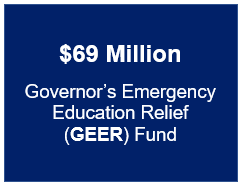
The purpose of the Governor’s Emergency Education Relief (GEER) Fund is to provide additional support to K-12 and Higher Education institutions that have been most significantly impacted by COVID-19. Funds received through GEER would generally supplement funds received by impacted institutions through the Elementary and Secondary School Emergency Relief (ESSER) and Higher Education Emergency Relief (HEER) Funds.

Important Notes:

  • GEER Funds cannot be used by states to replace state aid
  •  Education entities have broad discretion to determine the use of the emergency aid

A portion of GEER Funds must be used to provide emergency grants for K-12 LEAs that have been the most impacted by COVID-19.  ADE is tasked with determining indicators to identify which LEAs have been most significantly impacted by COVID-19

The following are indicators that are being considered to help determine LEAs that have been "most significantly impacted" by COVID-19:

Tribal Communities

  • Source: Tribal data
  • Challenges: Tribal data may be incomplete due to challenges in availability of data from tribal communities

LEA Ability to Support Online Learning

  • Source: Arizona Commerce Authority Broadband Office, LEA Survey Data
  • Local broadband infrastructure, broadband service availability, student access to internet services

COVID-19 Data

  • Source: State and County public health data
  • High COVID-19 cases per capita

Additional indicators that may be considered are family food insecurity (High percentage of families receiving NSLP/SNAP nutrition benefits), unemployment (High percentage of families unemployed due to COVID-19) and LEA demographics data (High percentages of low-income students, children with disabilities, English learners, racial and ethnic minorities, students experiencing homelessness, and foster care youth).

ADE FAQ: CARES Act FY20 Fiscal, Assessment & Accountability Waivers

ADE FAQ: CARES Act FY20 Fiscal, Assessment & Accountability Waivers

Fri, May 15, 2020

Under the CARES Act, the U.S. Secretary of Education has increased authority to provide education waivers related to assessments, accountability, and reporting requirements. Arizona has submitted and received approval for two waivers:

Fiscal Waiver

ADE will now be able to do the following:

  • Approve LEAs to carryover more than 15% of FY20 Title I-A funds even if the LEA received approval to exceed this limitation in the past three years
  • Extend the period of availability of FY19 funds to September 30, 2021 for the following ESSA grant programs: (Title I-A, I-B (State Assessment), I-C (Migrant), I-D (State Agency), II-A, III-A (EL), IV-A (Student Support and Academic Enrichment), IV-B (21st Century Community Learning Centers), V-B (RLIS), McKinney-Vento (Homeless)
  • Permit LEAs to use their FY20 Title IV-A funds to best meet local needs through waiving content-area minimum expenditure requirements (for LEAs receiving more than $30,000) and the 15% limit on technology-related purchases
  • Waive the ESSA definition of professional development for SY19-20 to allow ADE and LEAs to conduct time-sensitive, one-time, or stand-alone professional development activities

If your LEA would like to take advantage of this new flexibility for FY20 Title IV-A funds, please contact your Title IV-A Specialist.

Please also see the following FAQ for the FY20 Fiscal Waiver: ADE FY20 CARES Act Fiscal Waiver FAQ

Assessment and Accountability Waiver

The following are now waived for ADE for SY19-20:

  • Statewide assessment requirements
  • Requirements that a state identify new schools for comprehensive support and improvement and additional targeted support and improvement (CSI and TSI) based on SY 19-20 data, and freezes the current list of identified schools for SY 20-21
  • Report card provisions related to certain assessments and accountability

USED Fact Sheet: Select Questions Related to Use of Department of Education Grant Funds During the Novel Coronavirus Disease 2019

USED Fact Sheet: Select Questions Related to Use of Department of Education Grant Funds During the Novel Coronavirus Disease 2019

Fri, May 15, 2020

Fact Sheet: Select Questions Related to Use of Department of Education Grant Funds During the Novel Coronavirus Disease 2019

This fact sheet from the US Department of Education responds to frequently asked questions related to the use of grant funds from the U.S. Department of Education during the novel Coronavirus Disease 2019 (COVID-19) with respect to compensation, travel, and conference costs that are otherwise allowable costs under applicable program statutes and regulations. If you have additional questions or comments related to these questions and answers, please contact your Department program officers or send your questions to the following email address: [email protected]