Federal School Improvement
Welcome to the Federal School Improvement Unit within the Office of School Improvement of the Arizona Department of Education. We serve schools identified through Federal Accountability as in need of improvement. Our mission is to provide those supports and resources to improve educational outcomes for all students in Arizona.
Federal Accountability is governed by the Every Student Succeeds Act (ESSA) and the Elementary and Secondary Education Act (ESEA). The Arizona Consolidated State ESSA Plan defines the current rules, which are articulated in the Federal School Improvement Business Rules. Current Federal Business Rules can be accessed from the Technical Manuals & Codebooks section in Accountability & Research Resources.
General Identification Information
Gears Framework for Improvement
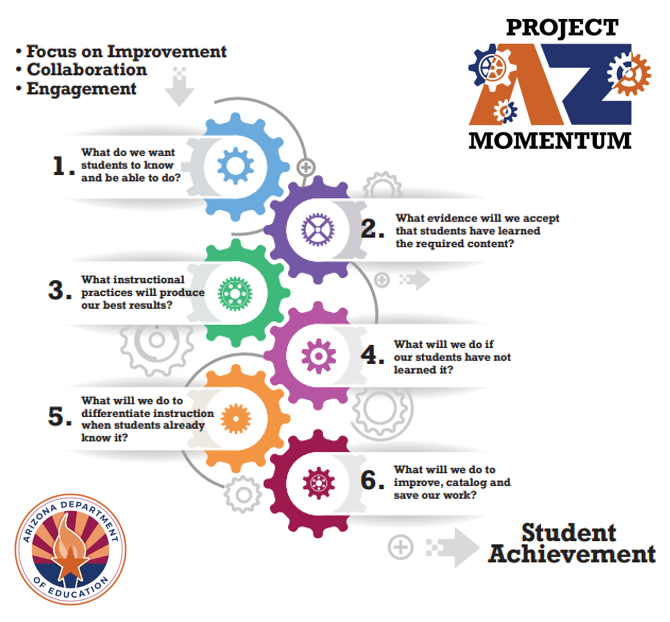
School Improvement is committed to helping educators do the right work using the adopted Project Momentum Gears Framework to ensure that all students succeed. Continual improvement to advance student learning is the mission of every school. The project model emphasizes the interconnected nature of the gears and recommends that they function best when initiated in sequence. LEAs engaging in the School Improvement adopted Project Momentum Arizona Gears Framework ensure their work remains focused on the continuous improvement actions proven most effective in supporting and sustaining student success. To help schools get started toward sustainable school improvement, educators are asked first to consider the six essential gears questions below:
Project Momentum Arizona ADEL Office of School Improvement Resources
Comprehensive Support and Improvement - Low Achievement (CSI-LA)
|
K-8 Schools
|
9-12 Schools
|
|
Combination to include Grade 12
|
Combination NOT including Grade 12
|
CSI-LA schools are identified every three years and, starting in 2025 (and impacting all prior identifications) have three years to exit.
CSI-LA schools failing to exit in three years are elevated to More Rigorous Options (MRO).
K-2 Model
The K-2 Model was eliminated in the 2025 Amendment cycle. All future K-2 schools will be nominally measured using the K-8 model, but more likely need to be considered using alternate methodology. Please refer to the business rules for prior identifications of K-2 schools, which can be accessed from the Technical Manuals & Codebooks section in Accountabiltiy & Research Resources.
Comprehensive Support and Improvement - Low Graduation Rate (CSI-G)
Every Student Succeeds Act (ESSA) requires state educational agencies to identify ALL public high schools in the state failing to graduate one-third or more of their students. To provide support, we have identified two groups:
|
Over 100 Total School Enrollment High schools with student enrollment above 100 (whole school) that are graduating less than ⅔rds of their 5-year cohort. |
Under 100 Total School Enrollment High schools with student enrollment under 100 (whole school) that are graduating less than ⅔rds of their 5-year cohort. |
*Special Note: Enrolled students is defined as the number of students in a school’s October 1 report that coincides with the identification year.
With respect to any high school identified in the state, the State Education Agency has discretion to permit differentiated improvement activities that utilize evidence-based interventions. This discretion is allowable in certain cases:
- Special Populations: In the case of such a school that predominantly serves students who are either
- returning to education after having exited secondary school without a regular high school diploma, OR,
- students, based on their grade or age, that are significantly off track to accumulate sufficient academic credits to meet high school graduation requirements, as established by the state.
- Small Schools: In the case of such a school that has a total enrollment of less than 100 students, permit the local educational agency (LEA) to forego implementation of improvement activities.
- Any high school having a total enrollment of less than 100 students may forgo implementation of improvement activities or opt-in per ESSA guidelines.
- If a high school with less than 100 students opts-in for improvement activities, they must meet all programmatic requirements.
- Identified schools forgoing implementation of improvement activities are not excused from identification and shall be measured and tracked like all other Low Graduation Rate schools.
NOTE: All schools identified for Low Graduation, regardless of population, size, or opt-in status, must meet the criteria to exit, and will retain their identification status until exit criteria have been met.
Targeted Support and Improvement (TSI) and Additional Targeted Support and Improvement (aTSI)
ESSA designates two types of Targeted Support and Improvement schools: Additional Targeted Support and Improvement (aTSI), identified every three years, and Targeted Support and Improvement (TSI), identified annually. Both ATSI and TSI are subgroup-based identifications, reflecting the performance of student subgroups within any school, regardless of Title I status.
Criteria:
- The N count is 20 student in a given subgroup.
- All major subgroups are included:
- Major ethnic/racial groups
- Income Eligible (IE12) - formerly economically disadvantaged)
- Students with Disabilities (SWD)
- English Learners Fluent English Proficient (ELFEP14)
Additional Targeted Support and Improvement (aTSI) schools are the schools that were first identified for School Year (SY) 2018-19, based on Spring 2018 AzMERIT scores. They are any school with any subgroup of students that, on its own, would lead to identification as Comprehensive Support and Improvement (CSI-LA), based on a Subgroup Achievement Score (SAS) in the bottom 5% of Title I schools based on CSI-LA criteria (at or below 21.99 total points earned in 2022).
The 2025 ESSA amendment changed the identification and exit timeframe: ATSI schools are identified every six years based on one year's prior data. Starting with the 2028 ATSI cycle, only schools previously eligible for TSI (see below) will be eligible for ATSI identification.
Title I schools with subgroups not exiting in six years shall elevate to Comprehensive Support and Improvement - Not Exiting ATSI Status (CSI-T), beginning in 2024-2025. Schools elevated to CSI-T not exiting in three years (by the 2028 cycle) shall elevate further to More Rigorous Options (MRO-T).
Targeted Support and Improvement (TSI) Schools are any school with consistently underperforming subgroups. They are reidentified every year based on three prior years' data.
The 2025 ESSA Amendment changed the TSI identification procedure away from the Subgroup Achievement Score, and to individual Subgroup Indicator Thresholds (SITH) for each available indicator for which a subgroup is eligible. Starting with the 2025 cycle, TSI schools are identified on a "proficiency-plus" determination for each of the prior three years of data.
Schools are eligible for TSI if:
- The subgroup's proficiency indicator is in the bottom 5th percentile of statewide results; and,
- Any other model indicator (i.e. growth, chronic absenteeism, graduation rate, etc...) is in the bottom 5th percentile of statewide results for that indicator.
If both of these requirements are true for each of the prior three years of data, the school is eligible for TSI for that subgroup. Note, the other model indicator does not need to be the same indicator for each of the three years. For example, a K-8 subgroup with sufficiently-low proficiency for three years may be identified if chronic absenteeism is low for the current year, EL results are low for the prior year, and Growth was low for the preceding year, or if one of those indicators was low for all three years, or any other such combination.
Further, TSI eligibility does not automatically result in identification. If a school is identified for any school-wide low-achievement identification (CSI-LA, MRO-LA, CSI-T, MRO-T), or the school is identified for ATSI for the same subgroup, TSI Eligibility is noted but the subgroup shall not be identified.
Prior TSI identification relied on a statistical measure of the subgroup's Subgroup Achievement Score (used for ATSI). In 2022, 2023, and 2024, schools with subgroups showing three prior years of data at least two full standard deviations below the statewide mean were eligible for TSI identification.
More Rigorous Options (MRO)Explore partnerships with Project Momentum and outside vendors to support schools identified for More Rigorous Options (MRO) based on previous identifications. HELPFUL RESOURCES: |
Four Domains for RenovationExplore a resource bank to help support the Local Education Agency (LEA) in transforming/improving systems, structures, and policies to advance positive, data-driven learning practices and leadership among educators, students, and families. HELPFUL RESOURCES: |
Data Analysis
Comprehensive Needs Assessment and Integrated Action Plan
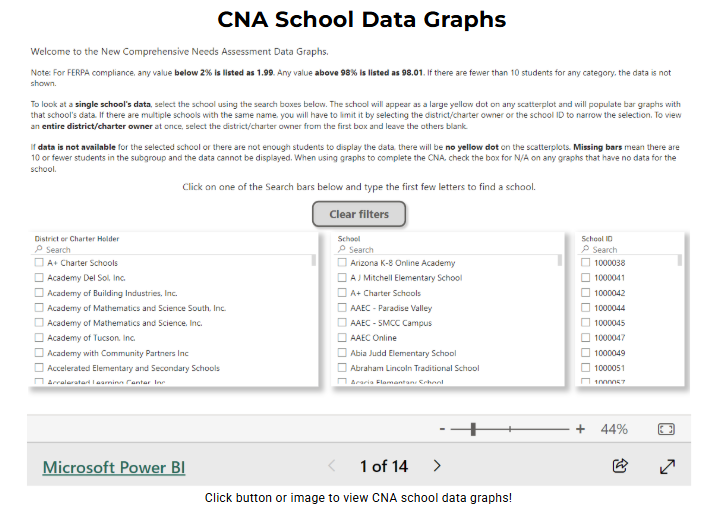
CNA IAP Information View CNA School Data Graphs CNA Graph User Manual
Identification and Static File
IMPORTANT NOTE: The formulas for identification and the static file structure have been updated since publication of the following resources.
Comprehensive Support and Improvement 101: Understanding Scores & Identification Process
HELPFUL RESOURCES: |
Comprehensive Support and Improvement 102 a: The Data Dashboard
HELPFUL RESOURCES: |
Comprehensive Support and Improvement 102 b: Querying the Static File
HELPFUL RESOURCES: |
Comprehensive Support and Improvement 103: Interrogating the Data
HELPFUL RESOURCES: |
ADEL Office of School Improvement Resources
Arizona Digital Educators Library - ADEL
ADEL is the Arizona Digital Educators Library, a digital ecosystem that provides curated, standards-aligned resources to support educators in instructional endeavors and enriching student learning to raise academic outcomes. Materials and resources available to Arizona educators in ADEL are safeguarded by specific and purposeful Guiding Principles to ensure quality, relevant, and accessible resources that form the cornerstone of our platform.
ADEL School Improvement Resources
HELPFUL RESOURCES:
ADEL AI Lesson Plan Companion
Evidence-Based Programs & Resources


ESSA Evidence-based resources top three (3) tiers
The Arizona Department of Education (ADE) neither endorses nor requires the use of any specific evidence-based clearinghouse; districts may use the clearinghouses or stand-alone research reviews conducted by a third party. Explore a variety of resources, evidence-based practices, and programs to support your school and district transformation on our Evidence-Based Practices webpage.
ADE Evidence-Based Practices USDE Evidence-Based Practices Guidance