Cognitive Models
Simple View of Reading
Nobody said reading is simple, and Philip Gough and William Tunmer didn’t either. Just as medicine has theoretical models, Gough and Tunmer created this formula in 1986 to clarify the role of decoding in reading comprehension. Over 150 empirical research studies have supported this formula.
Decoding (D) x Language Comprehension (LC) = Reading Comprehension (RC)
Simple right? Yes. Simple, but not simplistic! This formula was meant to be a 20,000-view. Each component is necessary, not sufficient. Over time, the weight of the two components shifts. Like a seesaw, the big words carry the meaning so older students still need “decoding/word recognition,” but as students become more proficient decoders, more weight can be focused on language.
Decoding (D)
- Phonological Awareness: Awareness of the sounds of words in learning to read and spell. (Note: The constituents of words can be distinguished in three ways: (1) by syllables, as /bo˘ok/, (2) by onsets and rimes, as /b/ and /o˘ok/, or (3) by phonemes, as /b/ and /o˘o/ and /k/. (cf. phonemic awareness).
- Decoding (and spelling): (reading). (1) Using one or more strategies to identify a printed word and its meaning; (2) Using knowledge of the logic of the written symbol system (especially letter–sound relationships and patterns in alphabetic orthographies) to translate print into speech; encoding involves translating speech into print using this knowledge.
- Sight Recognition of familiar words: (not sight words or high frequency words) any word whose pronunciation, spelling, and meaning are linked in long-term memory such that it is recognized automatically, effortlessly, and unconsciously when seen in print.
Language Comprehension (LC)
Language Comprehension: The ability to derive meaning from spoken words when they are part of sentences or other discourse.
- Background knowledge: The bank of knowledge one possesses based on life experiences and previous learning that is stored in memory and acquired over time.
- Vocabulary knowledge: A language user’s knowledge of words.
- Language structures: Written syntax, sentence structure, and text structure. Understanding how sentences are formed and how they convey meaning is critical to our ability to comprehend while we read.
- Verbal reasoning: The ability to put learning into words, to explain answers to the teacher’s questions, to infer, conceptualize, and frame thoughts in words – all of these ways of connecting ideas, comparing and contrasting ideas, combining ideas, verbalizing thinking are referred to as verbal reasoning.
- Literacy knowledge: The understanding that organizational differences and purposes exist among different text formats. For example, a poem has a different structure and purpose than an essay. Literacy knowledge includes familiarity with the different expository (non-fiction) text structures that authors use to organize information. These include description, sequence, compare, cause and effect, problem/ solution, as well as the use and purpose of headings, captions, and other organizational features.
For more information, visit the Reading Rockets Simple View of Reading site.
Scarborough's Reading Rope
Dr. Hollis Scarborough, American psychologist and literacy expert, is the creator of the famous Scarborough’s Reading Rope. Like Gough & Tunmer’s Simple View of Reading, Scarborough replicates the interconnectedness (and interdependency) between decoding and language comprehension in order to establish proficient reading.
These well-validated theoretical models inform educators what to test for and what to teach.
Proficient reading and reading comprehension are the ideal outcome, a product when all strands are tightly woven together. When even one strand is frayed or weak, the overall braided rope is compromised.
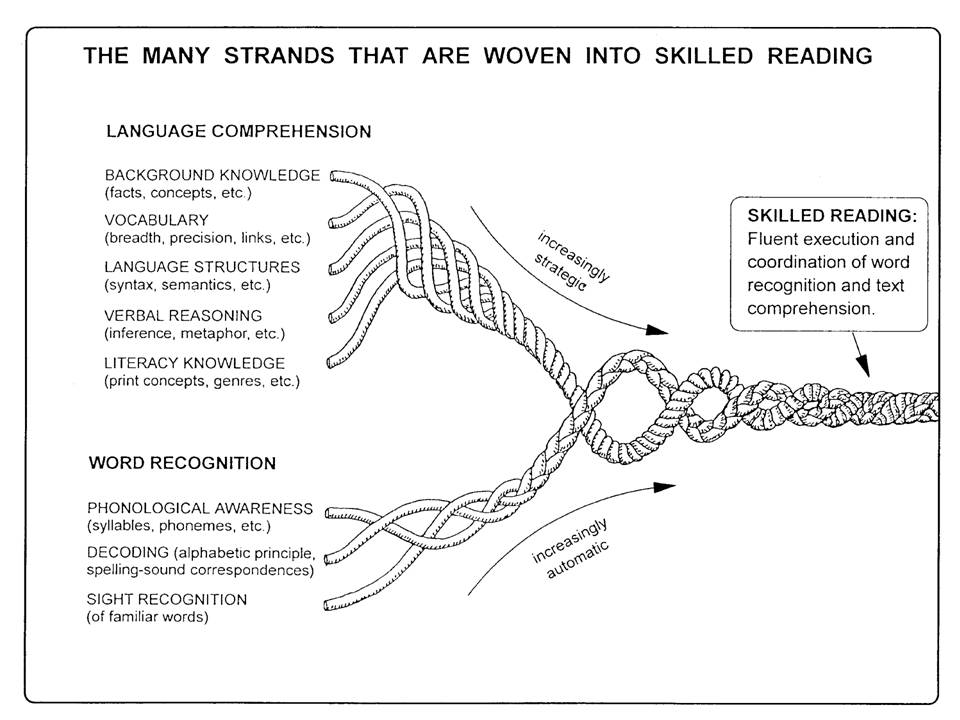
Image Credit: The image, courtesy of the author, originally appeared in the following publication: Scarborough, H. S. (2001). Connecting early language and literacy to later reading (dis)abilities: Evidence, theory, and practice. In S. Neuman & D. Dickinson (Eds.), Handbook for research in early literacy (pp. 97–110). New York, NY: Guilford Press.
Watch the video of the Animated Reading Rope - The Animated Reading Rope is one of hundreds of learning tools for educators in the AIM Pathways digital training platform.
The top 5 strands become increasingly strategic over time, even into adulthood.
- Background knowledge: The bank of knowledge one possesses based on life experiences and previous learning that is stored in memory and acquired over time.
- Vocabulary knowledge: A language user’s knowledge of words.
- Language structure: Written syntax, sentence structure, and text structure. Understanding how sentences are formed and how they convey meaning is critical to our ability to comprehend while we read.
- Verbal reasoning: The ability to put learning into words, to explain answers to the teacher’s questions, to infer, conceptualize, and frame thoughts in words – all of these ways of connecting ideas, comparing and contrasting ideas, combining ideas, and verbalizing thinking are referred to as verbal reasoning.
- Literacy knowledge: The understanding that organizational differences and purposes exist among different text formats. For example, a poem has a different structure and purpose than an essay. Literacy knowledge includes familiarity with the different expository (non-fiction) text structures that authors use to organize information. These include description, sequence, compare, cause and effect, problem/ solution, as well as the use and purpose of headings, captions, and other organizational features.
The bottom 3 strands become increasingly automatic over time, typically in early elementary school, usually in place by the end of 3rd grade, dependent upon explicit instruction during ELA reading block.
These strands describe how we interact with printed text.
- Phonological Awareness: Awareness of the sounds of words in learning to read and spell. (Note: The constituents of words can be distinguished in three ways: (1) by syllables, as /bo˘ok/, (2) by onsets and rimes, as /b/ and /o˘ok/, or (3) by phonemes, as /b/ and /o˘o/ and /k/. (cf. phonemic awareness)
- Decoding (and spelling): (reading). (1) Using one or more strategies to identify a printed word and its meaning; (2) Using knowledge of the logic of the written symbol system (especially letter–sound relationships and patterns in alphabetic orthographies) to translate print into speech; encoding involves translating speech into print using this knowledge.
- Alphabetic principle – a letter or letters represent a sound
- Spelling reinforces reading more than reading reinforces spelling
- Phonics – word study
- Syllable structure
- Morphology
- Etymology
- Sight Recognition of familiar words: (not sight words or high frequency words) any word whose pronunciation, spelling, and meaning are linked in long-term memory such that it is recognized automatically, effortlessly, and unconsciously when seen in print
**The views and opinions expressed in any third-party resource do not necessarily reflect those of the Arizona Department of Education (ADE) and do not imply an endorsement by ADE.
Four-Part Processor
The Four-Part Processing Model for word recognition is a simplified model that illustrates how the brain reads or recognizes words. (Based on Seidenberg & McClelland, 1989)
Magnetoencephalography (MEG) imaging studies have shown the directionality of brain processes when seeing/hearing a word.
- Orthographic processor: letter recognition
- When you see or hear a word, the orthographic processor makes a visual image of the letters
- Phonological processor: sound recognition
- The phonics “letterbox”
- Once the word is heard or read, the brain connects the letters/graphemes and sounds/phonemes
- Meaning processor
- All known meanings of the word are actively engaged
- Context processor: Confirming meaning
Watch Dr. Carol Tolman introduce her Tolman Hourglass Figure and its relation to the Four-Part Processor.