Structured Literacy
Structured Literacy is an approach to reading instruction that is characterized by the provision of systematic, explicit instruction that integrates (1) listening, (2) speaking, (3) reading, and (4) writing. A structured literacy approach emphasizes the structure of language across the speech sound system (phonology), the writing system (orthography), the structure of sentences (syntax), the meaningful parts of words (morphology), the relationships among words (semantics), and the organization of spoken and written discourse. (IDA/CERI, 2018c, March)
These principles tell us HOW we teach in all grades: | Teaching the structure of our English language includes these elements: |
|---|---|
|
|
Infographics
The Ladder of Reading and Writing
Visit Nancy Young's website to download a PDF version of The Ladder of Reading and Nancy's helpful primer on "What is structured literacy?".
The Ladder of Reading and Writing shows that a structured literacy approach is essential for at least 50-65% of our students, whereas the remaining 40% are still advantaged by a structured literacy approach. Also, you can read more on Nancy's blog.
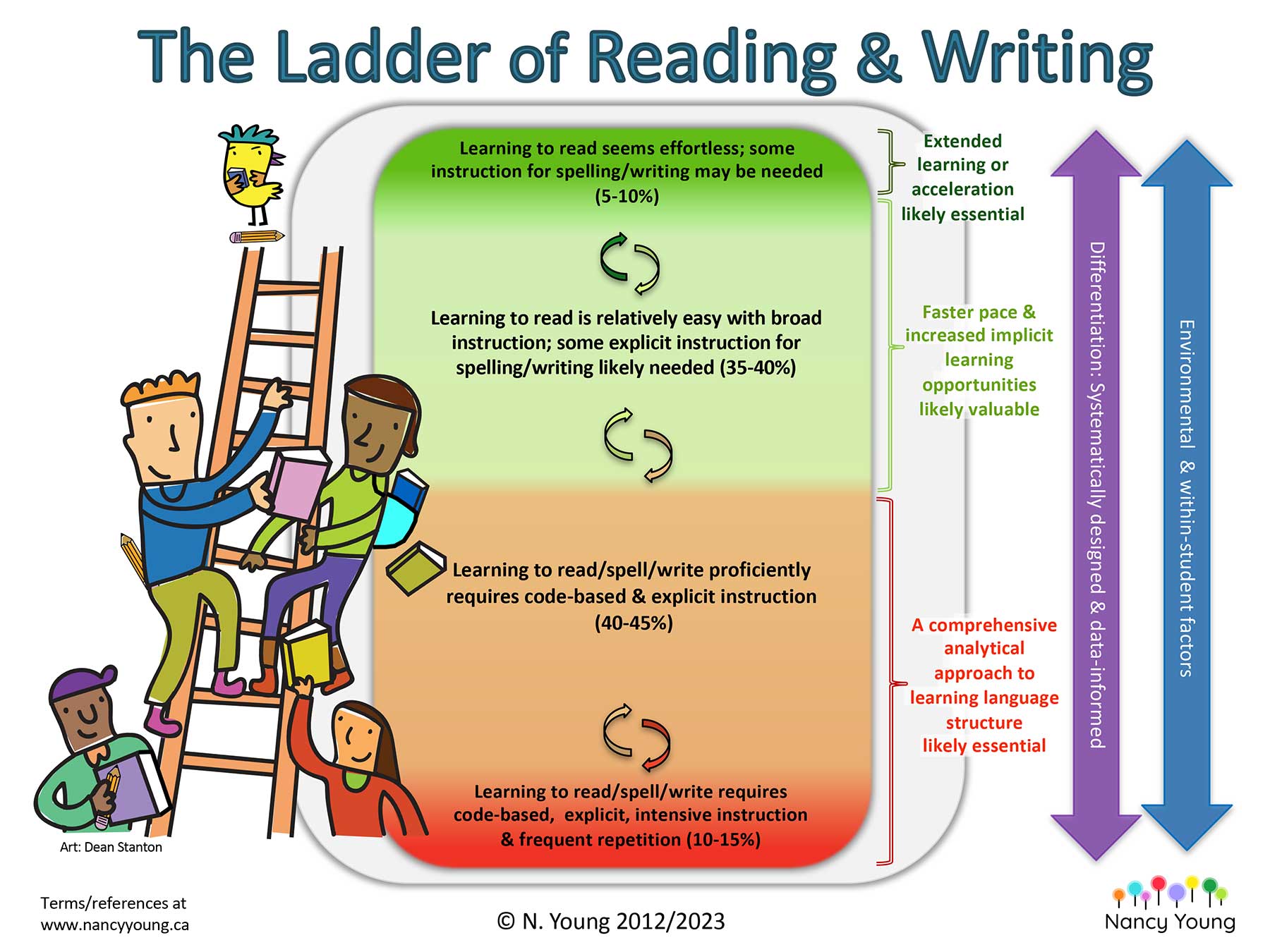
(Used with Nancy Young's permission)
Key Principles of Structured Literacy:
Explicit instruction – Explicit (direct) instruction is systematic, direct, engaging, and success-oriented, and has been shown to promote achievement for all students.
- Leaves nothing to chance with clear teacher modeling
- Demonstrates, and opportunity for practice
Systematic instruction – Systematic instruction in reading is a plan of instruction (e.g. scope and sequence) that takes students through an explicit sequence of learning activities.
- Easiest concepts to the most complex
Cumulative instruction – Skills and concepts that have been previously taught are consistently reinforced and practiced over time, building on what has come before, as you introduce new concepts and skills.
Diagnostic instruction – Teacher is consistently monitoring the progress of their students so they can intervene appropriately
Multisensory instruction - Instruction that provides explicit, direct instruction in the decoding and spelling of the language. Multisensory learning enhances memory and learning of written language through simultaneous use of visual, auditory, and kinesthetic-tactile pathways. Links are consistently made between the language seen (visual) and heard (auditory), and symbols felt (kinesthetic-tactile) while learning to read and spell.
**The views and opinions expressed in any third-party resource do not necessarily reflect those of the Arizona Department of Education (ADE) and do not imply an endorsement by ADE.