Work-Based Learning
| Updates |
|---|
|
Work-Based Learning Guidebook
Definitions:
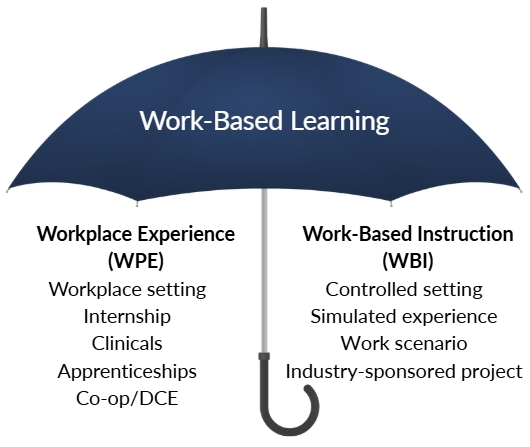
Perkins V: "The term 'work-based learning' means sustained interactions with industry or community professionals in real workplace settings, to the extent practicable, or simulated environments at an educational institution that foster in-depth, firsthand engagement with the tasks required in a given career field, that are aligned to curriculum and instruction."
Workplace Experience (WPE): sustained interactions with industry or community professionals in real workplace settings, to the extent practicable.
Work-Based Instruction (WBI): simulated environments at an educational institution that foster in-depth, firsthand engagement with the tasks required in a given career field, that are aligned to curriculum and instruction.
| WBL must: | WBL can: |
|---|---|
(WBL Guidebook page 4) |
(WBL Guidebook page 4) |
Acronyms and abbreviations in CTE
Models & Delivery Systems
Roles & Responsibilities
WBL that is developed locally can positively affect your community when the worksite, home, and school are all engaged and committed to success.
Responsibilities of the Student
Student Accountability:
- Student works with WBL Coordinator to establish goals for WBL experience.
- Student understands the expectations for business behavior.
- Anticipated learning outcomes are documented, and student is held accountable for achieving those expectations.
- The student should recognize that any WBL experience can be a life-changing opportunity.
Student Roles:
- Collaboratively develop goals and objectives.
- Make satisfactory academic progress.
- Immediately inform the coordinator of any problems that occur at the worksite.
- Be on time and display professional conduct at the worksite.
- Complete assignments, evaluations, forms, and other activities required by the coordinator and worksite.
Student Benefits:
- Apply program standards and technical skills.
- Build confidence.
- Improve judgment and decision-making.
- Understand the politics and expectations of the work environment.
- Gain reference for future employment.
- Motivation to stay in school and complete secondary education.
- Motivation to enroll in postsecondary education.
(WBL Guidebook page 16)
Responsibilities of the Business
Business Role:
- Co-create a training agreement and training plan.
- Interview students.
- Sign and abide by agreements and forms.
- Facilitate the student's exposure to all aspects of the field.
- Orient the student to the worksite with information about business operations, performance expectations, administrative policies, and job-specific training.
- Assist the student in their efforts to accomplish personal and professional goals.
- Meet with the WBL Coordinator during the duration of the student's experience to assess student progress and address issues that arise.
- Complete formal evaluations of the student's work and the WBL process.
Business Benefits:
- Creates a pool of skilled and motivated potential employees.
- Enables organizations to develop new projects with student assistance.
- Opens the door to involvement in curriculum development.
- Provides developmental opportunities for the current workforce.
- Offers opportunities to provide community services.
- Industry experience and current demands in the working classroom.
(WBL Guidebook page 17)
Parent Role:
- Encourage students to have good attendance at the worksite and school.
- Be involved and informed about the progress of students' work experience program.
- Provide transportation, as needed, to allow the student to work off school premises.
- Discuss work challenges with the student.
- Encourage student to set and work toward obtainable goals.
- Value and encourage continuing education with purpose.
- Parents will not always be involved in scenario or simulation-based WBL at the school.
(WBL Guidebook page 18)
Discussion, Planning, and Agreements:
- Each party must agree to the experience, including productivity, compensation, and learning.
- Length of the experience should be negotiated in advance.
- Agreements should detail student responsibilities.
Successful Planning and Management:
- Appropriate access is granted for the student.
- Activities are carefully planned and integrated into the curriculum.
- Student and WBL experience are carefully matched.
- Identify appropriate locations, jobs, and companies for students.
- Develop a formal, written training agreement that clearly documents both the training site and school commitment to the WBL experience.
- Coordinate with appropriate management personnel to identify who will serve as the student's training sponsor and mentor at the worksite.
- Carefully document training agreement and training plan to clarify learning expectations.
- Carefully document the scheduling of specific activities and assignments.
- Identify clear expectations for the student during the agreed-upon period of work.
- Coordinate regular visits. (i.e. once a week during the first two weeks, once every two weeks during the next 6-10 weeks, once a month for the duration of the experience, or on demand as necessary to mediate performance and ensure adherence to agreed upon training plan).
Required Documentation:
- Detailed description of the WBL experience
- Training agreement (include permission slips if required by District)
- Training plan with clear program-specific goals
- Wage and/or hour reports (hours only if unpaid)
- Journal or diary
- Visitation notes and reports (suggested)
- Employer evaluation reports (suggested)
- Resources and Sample Forms
Worksite Visit Details:
To protect the teacher and school from liability, worksite visits should be planned with the employer's consent and needs in mind. It is necessary to have the teacher visit the student at the worksite to ensure that training agreements and plans are being followed and the worksite remains safe.
Each visit should address some, or all, of the following:
- Observe the student
- Confirm parties' responsibilities and skills
- Check safety conditions
- Validate work hours and assist in future schedule negotiations
- Evaluate student performance on assigned responsibilities
- Check that duties and tasks are aligned with agreed upon training plan
- Assure compliance with laws
- Assist in negotiation of rewards and/or disciplinary actions
- Discuss additional opportunities for involvement in the program
- Make a courtesy call to senior management
Liability Concerns:
- Work with your district administrators to address school/district policies regarding student safety, security, legal obligations, and responsibilities.
- Some schools use The Trust to provide property and liability coverage or related services.
- All parties must become knowledgeable about laws governing students under 18 in the workplace.
- Every agreement used for WBL student participation must state that there is a safe working environment, including protection from discrimination and sexual harassment.
- Every agreement must state that the school has the right to immediately terminate the student in WBL if there is a breach of stipulated obligations.
- Policy and Legal Resources
(WBL Guidebook page 17)
All WBL activities should be approved by and adhere to District Governing Board policies and guidelines.
District/School Role:
Effective WBL must be a school or district initiative rather than the domain of a single individual. The best programs include coordinators, teachers, and counselors with active support from administration.
For maximum impact, school administration must be willing to:
- Minimize policy and regulatory impediments
- Take appropriate risks
- Support career guidance
- Provide planning and coordination time
- Facilitate partnerships throughout the community
- Encourage the involvement of all students and their parents
District/School Benefits:
- Expands curriculum and learning facilities.
- Provides access to state-of-the-art techniques and technology.
- Enhances the ability to meet the needs of diverse student populations.
- Promotes faculty interaction with the community.
- Contributes to staff development.
- Makes education more relevant and valuable for students.
- Encourages a cross-disciplinary dialogue regarding learning outcomes.
(WBL Guidebook page 17)
Resources & Sample Forms
Frequently Asked Questions
Are job shadows, guest speakers and field trips WBL?
Job shadowing, guest speakers, and field trips should be used as a tool prior to a WBL experience to help determine appropriate opportunities for individual student needs and goals, and to establish relationships with potential industry partners. High-quality programs of study do not merely provide students with isolated workplace exposure. Job shadows, guest speakers, and field trips/site tours will not be considered a WBL experience.
(WBL Guidebook page 4)
Yes. Many districts track their WBL experiences with tracking products. The ADE CTE WBL Data Portal can also be used as a tracking option. Districts will need to track experiences for CCRI points, which could be useful for audit purposes.
(WBL Guidebook page 4)
Districts and schools may choose to provide summer school internships, and it is a local decision to do so. ADM requirements must be met. For College and Career Readiness Indicator points, the 120-hour requirements will apply. The Summer School Internship model will require the same steps and documentation as a school-year internship.
(WBL Guidebook page 5)
From the State Board of Education College and Career Readiness Indicator Requirements, a well-defined Work-Based Learning experience of at least 120 hours must be in place. To meet these requirements, below is a list of recommendations for your WBL Experience descriptions:
- Parent or guardian agrees to accept responsibility for the student’s safety and conduct while traveling to and from school, place of employment, and home.
- The WBL teacher/coordinator will visit the WBL site prior to sending students to ensure that the proper safety and training conditions exist.
- Each WBL site must be visited periodically to check the student’s progress, attendance, appropriate work assignments, and safety.
- A training agreement and training plan must be on file.
- An employer/supervisor evaluation report must be on file.
- A student evaluation of their WBL experience must be on file
(WBL Guidebook page 4)
WPEs are sustained interactions with industry or community professionals in real workplace settings, to the extent practicable. WBIs are simulated environments at an educational institution that foster in-depth, firsthand engagement with the tasks required in a given career field, which are aligned to curriculum and instruction.
(WBL Guidebook page 2-3)
Discuss with your district administrators. Many schools use the Arizona School Risk Retention Trust to provide property and liability coverage. Schools may negotiate liability coverage responsibilities with the WBL industry partner, and should include district administrators and any other relevant parties in these discussions.
(WBL Guidebook page 14)
Required Documentation:
-
Detailed description of the WBL experience. WBL opportunity must be available to ALL CTE students
-
Training agreement (include District-mandated permission slips if required by District)
-
Training plan with clear program-specific goals
-
Wage and/or hour report (hours if not paid)
-
Journal/Diary
Other Documentation suggestions:
-
Visitation notes/reports
-
Employer evaluation reports
(WBL Guidebook page 5 & 12)
Federal Guidelines:
Sixteen- and 17-year-olds may be employed for unlimited hours in any occupation other than those declared hazardous by the Secretary of Labor. The Work Experience and Career Exploration Program (WECEP) offers exceptions to the child labor regulations that permit 14- and 15-year-olds to be employed in otherwise prohibited circumstances. WECEP is designed to provide a carefully planned work experience and career exploration program for students who can benefit from a career-oriented education. WECEP, among other things, is aimed at helping youths who are at risk for leaving school to become motivated to continue their education and to prepare them for the world of work.
State Departments of Education are granted approval to operate a WECEP by the Administrator of the Wage and Hour Division for a 2-year period. Certain provisions of CL Reg. 3 are modified for 14- and 15-year-old participants during the school term.
- They may work during school hours.
- They may work up to 3 hours on a school day; and as many as 23 hours in a school week.
- They also may work in some occupations that would otherwise be prohibited under a variance issued by the Administrator, but they may not work in manufacturing, mining or any of the 17 Hazardous Occupations.
USDOL Fair Labor Standards Act (FLSA) Advisor
Child Labor Requirements in Agricultural Occupations
Arizona Guidelines:
Arizona’s youth employment laws (A.R.S. § 23-230 et seq.) establish the hours youths can work and prohibit certain occupations in which they can be employed. Where there is a difference between federal and state law, the stricter law takes precedence.
Except for youths under the age of 16 working in the manufacturing and mining industries, the Occupational Restrictions are exempt under the following conditions:
- When youths are employed by a parent or relative and that person owns at least 10% of the company and is actively engaged in the daily operation of the organization.
- Federal Child Labor Law does not provide for a parental exemption from occupational restrictions. Under federal law however, there is a parental exemption for the number of hours a youth may work.
- When youths are employed as stars or performers in motion picture, theatrical, radio or television productions, provided the Department is notified in advance.
- When youths are employed in career education programs, vocational or technical training school programs. These programs must be recognized programs under the Department of Education pursuant to Title 15, Chapter 7, Article 5.
- When youths are employed as apprentices and registered by the Bureau of Apprenticeship and Training.
- When youths are employed under the 4-H Federal Extension Service or the United States office of education vocational agriculture training programs.
- When youths have completed vocational or career education programs approved by the Department of Education in which the programs are directly related to the prohibited occupation.
- When youths are legally married.*
- When youths have a high school diploma or its equivalent.*
*not recognized as federal exemptions
AZ Labor Department - Youth Employment
Additional State Labor Law Resources
(WBL Guidebook page 14-15)
Classroom labs should not be counted as WBL. While WBI activities may take place in the classroom lab space, all WBL activities, including WBI, should be distinct from classroom lab activities.
(WBL Guidebook page 1 & 3)
Contact
Deputy Associate Superintendent, Workforce Development
Robert Garcia
(602) 542-8789
[email protected]
Work-Based Learning Educational Specialist
Sara Zaccari
(602) 542-2968
[email protected]
Workforce Development Coordinator
Nohemi Camou
(602) 542-2285
[email protected]