Exceptional Student Services

Path
specialeducation
Contact
Contact name or title
ESS Reception Desk
Contact phone number
(602) 542-4013

DATA MANAGEMENT ALERT : Exceptional Student Services - Discipline Data Collection Application - New Action Taken Options

DATA MANAGEMENT ALERT : Exceptional Student Services - Discipline Data Collection Application - New Action Taken Options

DATA MANAGEMENT ALERT       

Exceptional Student Services (ESS) Discipline Data Collection (DDC) Application - New Action Taken Options

Effective May 3, 2023, new actions will be available in the Action Taken dropdown box and XML Schema. The following actions have been added:

  • Reassignment to Alternate Education Program In-School
  • Reassignment to Alternate Education Program Out-of-School
  • Reassignment to Alternate Suspension Program Out-of-School
  • Reassignment to Alternative Suspension Program In-School

Per Arizona State law, these actions must be taken in specific circumstances. If any student has been placed in an alternative education program per A.R.S. § 15-841(H) (I). These actions apply to school districts and charter school districts only. Please update the action taken for any student in this category.

As a reminder, all SPED discipline data must be completed by July 15, 2023.

Per A.R.S. § 15-841:

H. A school district or charter school shall expel from school for at least one year a pupil who is determined to have threatened an educational institution, except that the school district or charter school may modify this expulsion requirement for a pupil on a case-by-case basis if the pupil participates in mediation, community service, restitution or other programs in which the pupil takes responsibility for the results of the threat. This subsection shall be construed consistently with the requirements of the individuals with disabilities education act (20 United States Code sections 1400 through 1420). A school district may reassign a pupil who is subject to expulsion pursuant to this subsection to an alternative education program pursuant to subsection E of this section if the pupil participates in mediation, community service, restitution or other programs in which the pupil takes responsibility for the threat.  A school district or charter school may require the pupil's parent or guardian to participate in mediation, community service, restitution or other programs in which the parent or guardian takes responsibility with the pupil for the threat. For the purposes of this subsection, "threatened an educational institution" means to interfere with or disrupt an educational institution as defined in section 13-2911 by doing any of the following:

1. For the purpose of causing, or in reckless disregard of causing, interference with or disruption of an educational institution, threatening to cause physical injury to any employee of an educational institution or any person attending an educational institution.

2. For the purpose of causing, or in reckless disregard of causing, interference with or disruption of an educational institution, threatening to cause damage to any educational institution, the property of any educational institution, the property of any employee of an educational institution or the property of any person attending an educational institution.

3. Going on or remaining on the property of any educational institution for the purpose of interfering with or disrupting the lawful use of the property or in any manner as to deny or interfere with the lawful use of the property by others.

4. Refusing to obey a lawful order to leave the property of an educational institution.

I. Each school district shall establish an alternative to suspension program in consultation with local law enforcement officials or school resource officers. The school district governing board shall adopt policies to determine the requirements for participation in the alternative to suspension program. Pupils who would otherwise be subject to suspension pursuant to this article and who meet the school district's requirements for participation in the alternative to suspension program shall be transferred to a location on school premises that is isolated from other pupils or transferred to a location that is not on school premises. The alternative to suspension program shall be discipline intensive and require academic work, and may require community service, groundskeeping and litter control, parent supervision, and evaluation or other appropriate activities. The community service, groundskeeping and litter control, and other appropriate activities may be performed on school grounds or at any other designated area.

If you have any questions or concerns, don't hesitate to get in touch with us at [email protected].

PS & Monitoring: Hot Topic Special Education Early Childhood Transition

PS & Monitoring: Hot Topic Special Education Early Childhood Transition

Recently, ADE/ESS has received many inquiries regarding special education Early Childhood Transition for children referred from IDEA Part C, Arizona’s Early Intervention Program (AzEIP). The attached Hot Topic is intended to provide guidance to address these responsibilities.

For additional compliance-related questions, please contact the PEA’s assigned Program Support and Monitoring (PSM) specialist. If there are questions related to implementing effective preschool special education programs, please contact the PEA’s assigned Early Childhood Special Education (ECSE) specialist.

DATA MANAGEMENT : Special Education Data Updates Webinar Wednesday, May 17th

DATA MANAGEMENT : Special Education Data Updates Webinar Wednesday, May 17th

DATA MANAGEMENT ALERT        

Special Education Data Updates Webinar Wednesday, May 17th  

The Exceptional Student Services Data Management team will host the next Special Education Data Updates live webinar on Wednesday, May 17th, from 2pm – 3pm. This session will cover a variety of data topics that will include (subject to change):    

  • Reminders  
  • Trending topics  
  • Top 3 Integrity Errors  
  • Q&A 

For questions, please contact ESS Data Management via email at [email protected].  

DISPUTE RESOLUTION INFO: Change in Procedure Regarding Offer of Early Resolution in Response to a State Complaint

DISPUTE RESOLUTION INFO: Change in Procedure Regarding Offer of Early Resolution in Response to a State Complaint

Tue, Apr 25, 2023

Please see the attached Memorandum regarding a change in procedure to the Offer of Early Resolution in Response to a State Complaint. This change is occurring following an administrative review of the state complaint process and considers guidance from the Arizona Attorney General’s Office, as well as technical assistance received by national technical assistance groups regarding Dispute Resolution activities.

Please contact ADE/ESS Dispute Resolution with any questions about this change in procedure.

Early Childhood Special Education and Assistive Technology

Early Childhood Special Education and Assistive Technology

Assistive Technology Information and Resources for Practitioners Supporting Children with Disabilities in Early Childhood

Overview of AT in ECE 

Assistive technology can be thought of as any item that supports a child's ability to participate actively in his or her home, childcare program, school, or broader community setting. The Arizona Department of Education's Exceptional Student Services Assistive Technology team offers many tools and resources for pre-k to grade 12. The following tools and resources are specific to early childhood. 


Roles Involved in Providing and Supporting Assistive Technology

Role of Speech Language Pathologists in Providing AT Services

Role of Occupational Therapists in Providing AT Services

Role of Physical Therapy in Providing AT Services

Overview of AT in ECE

PACER Center: AT for ECE

Examples of AT in Early Childhood

Obtaining AT through ADE

Vendor/Exhibitor Application is Open for the 2023 IDEA Conference

Vendor/Exhibitor Application is Open for the 2023 IDEA Conference

Special Education Stakeholders,

ADE/ESS is excited to share the Vendor/Exhibitor Application for Arizona’s 2023 IDEA Conference: Creating Connections and Strengthening Systems. This year’s conference will be held August 21–23, 2023 at the JW Marriott Desert Ridge in Phoenix. 

A limited number of in-person tables will be available. Space is not guaranteed. Selections for tables will be based on agency priority.

If interested, please complete the Vendor/Exhibitor Application by Friday, May 19, 2023. 

For more information about the IDEA Conference, visit the IDEA Conference website. Questions about the conference can be sent to the IDEA Conference inbox.

Arizona Professional Learning Series (AZPLS)

Arizona Professional Learning Series (AZPLS)

The Arizona Professional Learning Series (AZPLS) provides district and school teams with a process to guide and assist in building a foundation for systems change that will impact literacy outcomes by closing the achievement gap for students with specific learning disabilities. Every part of the professional learning series will empower students to be successful learners in a safe, supportive, and inclusive learning environment.

Collaboration is the key for a whole school to be effective. District and school site leaders will learn the importance of including the entire school community in creating a collaborative culture that supports high expectations for all students. Leadership will apply strategies of intentional collaboration to support teamwork for collective learning and implementation. Leadership will identify how inclusive collaboration connects every teacher to impact student achievement. 

Research shows that schools that support teacher collaboration tend to have higher student achievement than less collaborative schools. According to John Hattie, collective teacher efficacy has the greatest impact on student achievement.

AZPLS Modules

There is a well-planned progression to the AZPLS modules. The organization of the modules, implementation, data analysis, and coaching provide a supportive process for increasing knowledge, skills, and achievement. Participants collaborate to learn and implement strategies that support inclusionary practices to increase student literacy achievement. These practices bring general education teachers, special education teachers, and content area teachers together to use evidence to drive instruction and collaboratively plan the teaching and learning of all students. 

ADE provides the module packages, which include the presentation, facilitator guide, participant packet with handouts, posters, activities, parent modules to share strategies, and technical assistance to support leadership and school staff who facilitate the modules. The Arizona Professional Learning Series Module Overview provides the module topics and briefly describes each module. 

Arizona Professional Learning Series Module Overview

AZPLS Program Design

The AZPLS program design is rooted in systems change and connects the district, school staff, students, and parents. Six systems are embedded into the modules to support sustainable implementation. All professional learning interconnects with leadership, coaching, teams, data, and action planning to reinforce the teaching and learning strategies that will increase literacy achievement for every student in every class. 

Program Design Overview

AzPLS Websites

The AZPLS offers two websites for participating schools. The websites are linked seamlessly so schools can access the high-quality professional learning supported by data collection and analysis. 

The Arizona Professional Learning Series Website provides: 

  • Professional Learning Modules and Materials 
  • Parent Modules and Materials 
  • Teams, Data, Action Planning, and Coaching Guides 
  • District Leadership Team Meeting Materials 
  • Videos of Arizona Teachers Implementing AZPLS 

The Arizona Professional Learning Series Data Portal provides: 

  • Data Tools 
  • Supporting Documents 
  • Real-time Data Analysis 
  • Secure Log-in Access Only 

AZPLS Videos

Videos supplement module content and demonstrate specific strategies through examples from Arizona schools. Videos can be used by presenters, coaches, teams, and individuals.

AZPLS Videos

AZPLS Implementation with Sustainability

The AZPLS modules are facilitated by a teacher leader on staff at each school or district. Between module presentations, time must be allotted for initial strategy implementation and support for teachers, practice with specific teaching and learning strategies, and plans for sustaining the strategy use. Options are available to meet any need. 

By the end of this professional learning series, leadership, teachers, students, and parents will have gained the knowledge and skills to impact literacy learning for every student in all classrooms across their school campus, and districts and schools will have well-developed systems for ongoing reflection and growth toward meeting the needs of all learners. 

Contact Information

Academic Achievement & Inclusive Practices Inbox

Page revised 3/13/25

Assessing Outcomes for Preschool Children with Disabilities 

Assessing Outcomes for Preschool Children with Disabilities 

Bottom of Form

The Child Outcomes Summary Process

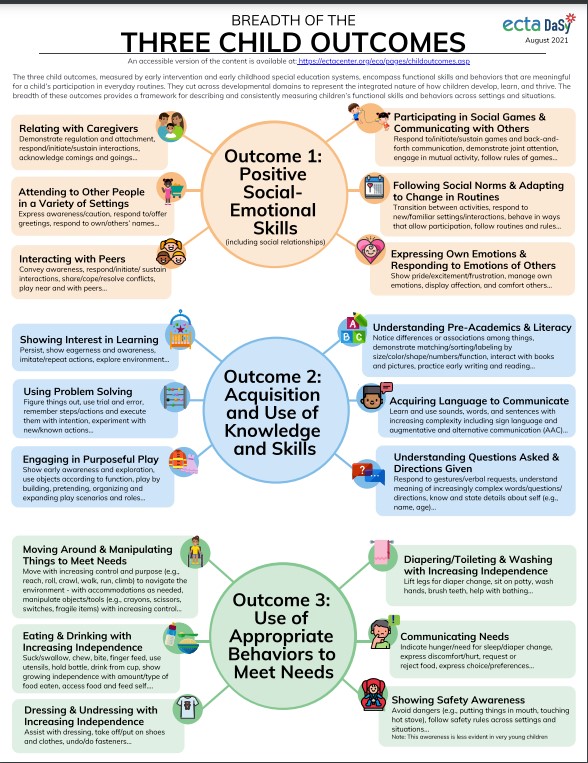
The Child Outcomes Summary (COS) is a team-based process to assess a child's functioning in three outcome areas using a 7-point scale. A team of individuals who are familiar with the child consider multiple sources of information about the child’s functioning to determine the ratings. The documentation of the child’s performance across settings involves parents and other caregiver observations to complete the assessment.

The three areas in which a child’s outcomes are reported are:

  • Positive Social Emotional Skills
  • Acquisition and Use of Knowledge and Skills
  • Use of Appropriate Behaviors to Meet Needs

The ADE will no longer require PEAs to use a single tool to report child outcomes, rather, schools may conduct the Child Outcomes Summary Process using district-selected methods and tools. PEAs may select a preferred tool and train staff on the procedures to conduct the child outcomes assessment to determine outcomes ratings. The process must result in reliable and timely data submissions. The Child Outcomes Scores must reflect the IEP team's view of the child's performance upon entry of each child into the program and upon their exit.

Professional development is available to all Public Education Agencies to support the use of a high-quality COS process.

Purpose for Assessing Child Outcomes

Children's outcomes are assessed for several reasons:

  • Federally reported data is used to determine if federal funding for provision of early childhood special education is making a difference for young children with disabilities and their families.
  • State and Local Programs use results to know how well programs are serving children and families and how to help programs improve.
  • Data is shared with Family and Community Members, so they know how children and programs are doing.
  • Teachers use the results to inform instruction in the classroom.

Reporting Child Outcomes 

Public Education Agencies (PEAs) will provide the Arizona Department of Education (ADE) with Child Outcomes Summary ratings for each outcome area upon entry of each child to a preschool special education program or service. PEAs will provide exit scores when the child leaves the program or service to enroll in kindergarten or is no longer considered a child with a disability. PEAs will also submit scores for each outcome area at the end of each school year. Data for child outcomes will be reported through the Arizona Education Data System (AzEDS) and reports, such as the SPED11 report, will be available for districts to review. The ADE will calculate summary data, such as Developmental Trajectories and Summary Scores, from the entry and exit COS scores for federal reporting. ESS Data Management published a technical assistance manual on Preschool Outcomes Data Submissions into AzEDS. This manual includes sections on Rating Scores, Progress Categories, Measurement Calculations, and AzEDS Data Transactions.

Entry, Exit, End of Year Definitions, and Data submission time frames:

  • Entry: preschool aged children who have been evaluated and found eligible for special education, have an IEP and enroll in the district preschool program or receive special education services are considered to have entered the program. The level of performance upon entry reflects the child's current functioning prior to receiving preschool special education supports and services. The child's rating on the 7-point scale upon entry is used as a baseline score for the child's overall performance in each outcome area and will be compared to their performance at the end of the year and at the end of the preschool program. An entry score must be submitted without delay, and no later than two weeks after enrollment in the program on all three outcome areas (Social Emotional, Knowledge and Skills, Behaviors to Meet Needs). Integrity will fail until the information is provided.
  • Exit: preschool aged children who attended a preschool special education program or received a special education service will receive a rating on the 7-point scale at the end of the program.   This rating is expected to be submitted within 15 calendar days after the child exits the preschool special education program on all three outcome areas. Other exit scenarios include children who exit from special education or the program ends when the child is eligible for Kindergarten, or children who end the program as the result of a 10-day mandatory withdrawal. In each case the district will submit an outcome rating for all three outcome areas. If preschool program exit dates are prepopulated by a student information system, scores shall not be submitted prior to the exit date.
  • End of Year: preschool children with disabilities who attended the district preschool special education program or received special education services will submit a rating on the 7-point scale to represent the status of the child at the end of the school year. The child is not exiting from the program or from services, but rather is expected to be continuing on the following year as a preschool-aged student. This rating is expected to be submitted within 15 calendar days after the child exits the preschool special education program on all three outcome areas. If preschool program exit dates are prepopulated by a student information system, scores shall not be submitted prior to the exit date.


INTERNAL PD INFO—Implementing SB 1654: How Schools Can Successfully Meet the Law’s Requirements and Establish Seizure Action Plans

INTERNAL PD INFO—Implementing SB 1654: How Schools Can Successfully Meet the Law’s Requirements and Establish Seizure Action Plans

Thu, Apr 13, 2023

The Arizona Department of Education (ADE) is hosting a free discussion on implementing SB 1654 (Seizure Safe Schools). During this session, participants will receive information about the law and step-by-step details for complying with the law, hear about training requirements, and participate in a Q&A session where submitted questions will be answered. In addition, resources about seizure action plans and seizure first aid will be provided.

Date and Time: April 20, 2023, at 3:00 p.m.

Topics of Discussion:

  • Introduction of SB 1654; schools, seizure management, and treatment plans
  • History of the bill, why it is needed, and how it will help AZ students
  • Key components of the bill and timeline for implementation
  • Amended Model Board Policy for school districts and charter schools
  • New Seizure Action Plan (SAP) Template
  • History and purpose of model SAP Template through the perspective of a Pediatric Neurologist
  • Arizona State Board of Education: Approved Training and Related Training Requirements
  • Training Session Approval Guidelines, Review Process, and Seizure Action Plan Committee
  • Resources and materials available for implementation
  • Review of timeline and steps for successful implementation
  • Q&A

Target Audience:  School nurses and health office staff, school administrators, and other school staff involved in implementing Seizure Safe Schools. Anyone interested in providing the program for their students and school is welcome to attend as well.

Register for Implementing SB 1654.

Data Management Alert: Special Education Data Updates Webinar Wednesday, April 19th

Data Management Alert: Special Education Data Updates Webinar Wednesday, April 19th

DATA MANAGEMENT ALERT       

Special Education Data Updates Webinar Wednesday, April 19th 


The Exceptional Student Services Data Management team will host the next Special Education Data Updates live webinar on Wednesday, April 19th, from 2pm – 3pm. This session will cover a variety of data topics that will include (subject to change):   


  • Reminders 
  • Trending topics 
  • Top 3 Integrity Errors 
  • Q&A    


Registration is required to attend: Register for Special Education Data Updates webinar.   


For questions, please contact ESS Data Management via email at [email protected].