Arizona Mathematics Standards
(Adopted December 2016)
The Arizona Mathematics Standards define the knowledge, understanding, and skills that need to be taught and learned so all students are ready to succeed in credit-bearing, college-entry courses and/or in the workplace. The Arizona Mathematics Standards are the foundation to guide the construction and evaluation of mathematics programs in Arizona K-12 schools and the broader Arizona community. These standards were adopted by the Arizona State Board of Education in December 2016.
Grades K-5 Standards
Intro. to the Arizona Mathematics Standards | Glossary
| K-5 Standards | K-5 Standards Placemats |
|---|---|
| Kindergarten Standards(Updated 4.2.18) wrd|pdf|CASE | Kindergarten Standards (Updated 4.18) wrd|pdf|CASE |
| First Grade Standards (Updated 4.2.18) wrd|pdf|sp|CASE | First Grade Standards (Updated 4.18) wrd|pdf|CASE |
| Second Grade Standards (Updated 4.2.17) wrd|pdf|CASE | Second Grade Standards (Update 4.18) wrd|pdf|CASE |
| Third Grade Standards(Updated 4.2.18) wrd|pdf|CASE | Third Grade Standards (4.18) wrd|pdf|CASE |
| Fourth Grade Standards(Updated 4.2.17) wrd|pdf|CASE | Fourth Grade Standards (4.18) wrd|pdf|CASE |
| Fifth Grade Standards (Updated 4.2.18) wrd|pdf|CASE | Fifth Grade Standards (4.18) wrd|pdf|CASE |
| K-5 Progression Documents | K-5 Emphasis Documents |
|---|---|
| Kindergarten Google | Kindergarten |
| First Grade | 1st Grade |
| Second Grade | 2nd Grade |
| Third Grade | 3rd Grade |
| Fourth Grade | 4th Grade |
| Fifth Grade | 5th Grade |
The Arizona Mathematics Progression Documents are a great place to start with curriculum mapping and scope and sequence. Please also reference the major and supporting content emphasis documents. These documents provide information that will assist you in determining how much instructional time you should spend on different clusters of math content and each grade or in each high school course.
Even though the Arizona Mathematics Standards were reviewed and revised in 2016, it is suggested that you still utilize Common Core math support documents to assist with planning, curriculum design, and professional development. Please make sure that you are analyzing the Arizona Mathematics Standards for alignment with the Common Core Math Standards. There are some differences between the Common Core and the Arizona Mathematics Standards. However, support materials are still beneficial in planning and in getting to know the content standards.
Here are additional reliable and valid progression documents to assist your planning.
Progression Documents for the Common Core Math Standards The Common Core State Standards in mathematics were built on progressions: narrative documents describing the progression of a topic across several grade levels informed both by research on children's cognitive development and by the logical structure of mathematics. These documents were spliced together and then sliced into grade-level standards. Progression documents can explain why standards are sequenced the way they are, point out cognitive difficulties and pedagogical solutions, and give more detail on particularly tricky areas of mathematics. Progression documents should be useful in teacher preparation and professional development, organizing curriculum, and writing textbooks. Progression documents also provide a transmission mechanism between mathematics education research and standards. Research about learning progressions produces knowledge that can be transmitted through the progressions document to the standards revision process; questions and demands on standards writing can be transmitted back the other way into research questions.
*Please contact the Academic Standards Math Team for an accessible version.
Grades 6-8 Standards
Guidance for Middle School Mathematics
Middle School Math Webinar
House Bill 2477
(Adopted during the Fifty-third Legislature Second Regular Session, 2018)
Notify Parents if students were not proficient on the statewide assessment for Math.
HB 2477 requires LEAs to provide parents with written notice that includes:
1. What the student's mathematics deficiencies were on the statewide Math exam; and
2. How those deficiencies are being addressed through services provided to the student, which could include supplemental instruction and any supporting programs designed to address the student’s specific mathematics deficiencies. LEAs are required to provide notice to parents regarding the Spring statewide assessment results by the first half of the second quarter of this school year if students scored in the minimally proficient or partially proficient range on the statewide Math assessment. LEAs can identify how below mastery in the scoring category is being addressed through Tier 1 (first instruction), Tier 2 (supplemental instruction), and possibly through supporting programs, which could include but are not limited to after-school tutoring.
The ADE Assessment and K-12 Standards Team has created a sample letter that you can customize with your school letterhead and site-specific supplemental instruction and/or supporting programs specific to the individual student. Understanding in Mathematics, when a student understands a mathematical concept, they move fluidly between the concrete and abstract. There is evidence that they can make sense of and justify mathematical connections. Evidence of understanding includes connections among:
♦Verbal or written reasoning ♦Pictorial representations ♦Real-world application ♦Procedures/Computation
Intro. to the Arizona Mathematics Standards | Glossary
*Please contact Academic Standards for accessible versions.
| Grades 6-8 Standards | 6-8 Standards Placemats |
|---|---|
| Sixth Grade Standards (Updated 4.2.18) wrd|pdf | Sixth Grade Standards (4.18) wrd|pdf |
| Seventh Grade Standards (4.18) wrd|pdf | Seventh Grade Standards (Updated 4.2.18) wrd|pdf |
| Eighth Grade Standards (4.18) wrd|pdf | Eighth Grade Standards (Updated 4.2.18) wrd|pdf |
The Arizona Department of Education K-12 Standards Section is providing planning guidance regarding the major and supporting clusters found within the Arizona Mathematics Standards, adopted in 2016. The Math Workgroup has made changes to the content emphasis documents (below) based on what we have learned since 2010. Please consider the following designations when planning an instructional scope for the school year. The ADE is suggesting instructional time encompassing 70% for Major Clusters at each grade level/course.
| Mathematics Content Emphasis Documents |
|---|
6-Algebra 2 AZ Mathematics Progression Documents
Thank you to the East Valley Mathematics Leaders Group and the Peoria District Math Team for completing the Arizona K-5 Mathematics Progression Documents. The East Valley Math Leaders met throughout the 2018-2019 year to complete the work on the 6-Algebra 2 progression documents.
The Arizona 6-Algebra 2 progression documents are one way to look at the progression of standards across grade levels and courses. The specific pathway that was utilized in these progressions is a progression around and through Number sense. Number Sense is the “big idea” across all the progressions. Number Sense then has pathways into Statistics, Expressions and Equations, and Proportional Reasoning. Proportional Reasoning is a giant and has pathways into Functions, Probability, and Congruence/Similarity.
Please open the Progression document, then click the link on each of the progressions to see how content progresses from 6th grade all the way through to Algebra 2.
*Please contact the Academic Standards Math Team for an accessible version.
Grades 9-12 Standards
Intro. to the Arizona Mathematics Standards | Glossary
|
AZ Mathematics Standards: High School |
Content Emphasis Documents |
|---|---|
| High School Placemats |
|---|
| Algebra 1 Placemat (Updated 3.23.23) wrd|pdf |
| Geometry Placemat (Updated 3.23.23) wrd|pdf |
| Algebra 2 Placemat (Updated 3.23.23) wrd|pdf |
High School Placemats
Thank you to Ryan Carle-Ogren from Sahuarita High School for completing the Arizona High School Mathematics Placemats.
*Please contact the Academic Standards Math Team for an accessible version.
Math Resources
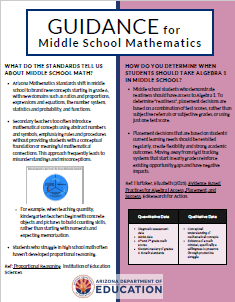
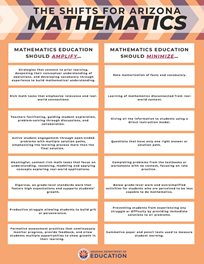
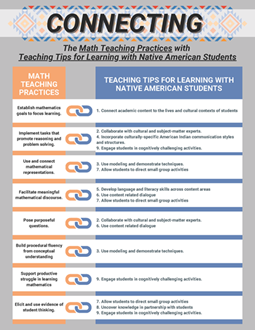
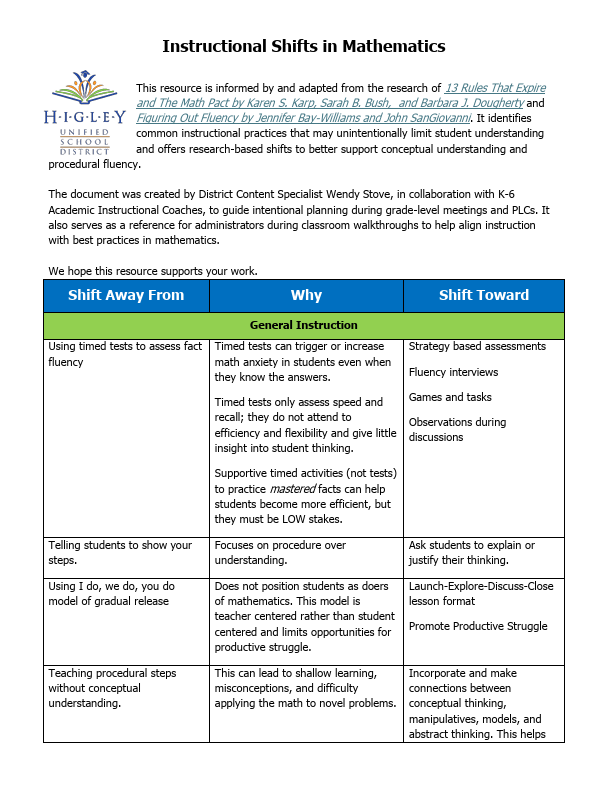
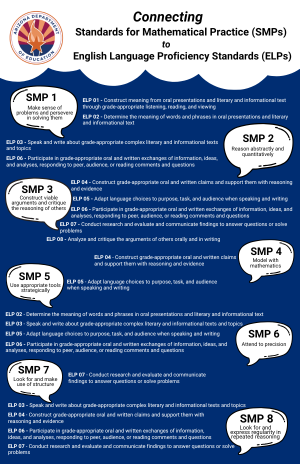
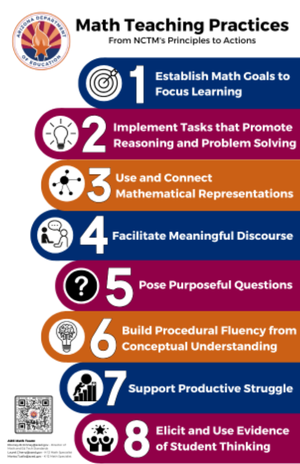
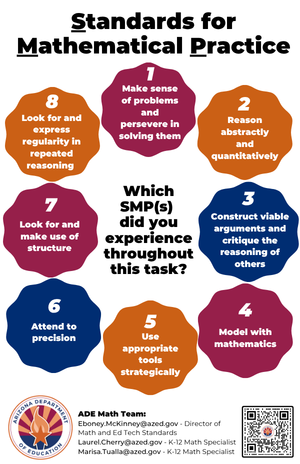
| Guidance for Middle School Mathematics | Connections for Success (CFS) | The Shifts for Arizona Mathematics | The Math Teaching Practices with Teaching Tips for Learning with Native American Students | Instructional Shifts in Mathematics |
|---|---|---|---|---|
 |
 Connections for Success (CFS) was developed after House Bill 2135 was passed in 2021. CFS focuses on high school math standards, specifically Algebra 1, Geometry, and Algebra 2. Each document highlights a standard cluster and its vertical alignment to prior and upcoming standards. |
 |
 |
 |
|
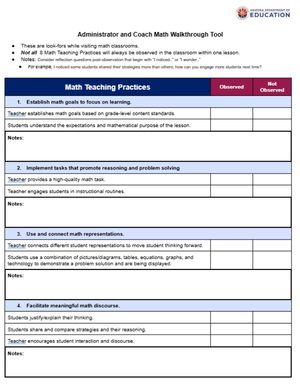
Administrator and Coach Math Walkthrough (Aligned to MTPs) |
|||
|---|---|---|---|
 |
 |
 |
 |
Reach out to Academic Standards for an accessible copy of any of these files.

Mathematics and Statistics Awareness Month
Month of March: Math & Statistics Month
MATH AND STATS BINGO
Additional Math Resources
Achieve the Core has a Coherence Map for mathematics from kindergarten through Algebra 2. Standards relate to one another, both within and across grades. The Coherence Map is an interactive website that illustrates the coherent structure of the Common Core State Standards for Mathematics, K–High School. This site provides one representation of how the standards are connected and is derived from this wiring diagram. A great video is linked to the site that illustrates the importance of coherence in mathematics. The Coherence Map shows the connections between the common core state standards for mathematics.
Data Literacy and Data Science
Administrators
Fourth Credit High School Guidance and Standards
The development of the fourth credit guidance and standards began in January 2017 under the guidance of the Arizona Department of Education. A statewide committee of high school mathematics teachers, district Mathematics Specialists and Professors, and Mathematicians from Institutes of Higher Education reviewed research and other state standards to create the general guidance and standards related to fourth-credit mathematics. The Quantitative Reasoning and Precalculus Standards are also aligned with the high school Plus Standards. Standards outline what a student needs to know, understand, and be able to do by the end of each grade. Standards are built across grade levels in a progression of increasing understanding and through a range of cognitive demand levels. Standards are adopted at the state level by the State Board of Education (A.R.S. §§15-701 and 15-701.01). Arizona retains the authority to approve and modify academic standards; there is no federal law requiring the adoption of specific standards. The fourth-credit standards for Quantitative Reasoning and Precalculus are not board-adopted since fourth-credit mathematics courses are a local control decision.
These documents represent guidance only for schools and districts. It is a local control decision what courses are offered in a four-credit mathematics pathway.
Fourth Credit Math General Guidance (Sept. 2018), Arizona Precalculus Standards (Sept. 2018) Arizona Quantitative Reasoning Standards (Sept. 2018)
*Please contact The Academic Standards Math Team for an accessible version.
Summary of Revisions & Planning Documents
Summary of Revisions & Planning Documents
SUMMARY OF REVISIONS AND PLANNING DOCUMENTS: K-8 & HS
| Grade | WORD | |
|---|---|---|
| Kindergarten (Updated 5.10.17) | wrd | |
| First Grade (Updated 7.27.17) | wrd | |
| Second Grade (Updated 7.27.17) | wrd | |
| Third Grade (Updated 7.20.17) | wrd | |
| Fourth Grade (Updated 7.20.17) | wrd | |
| Fifth Grade (Updated 7.20.17) | wrd | |
| Sixth Grade (Updated 8.16.17) | wrd | |
| Seventh Grade (Updated 8.16.17) | wrd | |
| Eighth Grade (Updated 3.28.17) | wrd | |
| Algebra 1 (Updated 8.16.17) | wrd | |
| Algebra 2 (Updated 5.1.17) | wrd | |
| Geometry (Updated 8.16.17) | wrd |
Recommended Instructional Minutes
Follow our AZ Math Professional Learning Calendar Sign up for the Math Mailing List
Access ADEL Standards Aligned Resources
Look for the word CASE next to each of our Word and PDF files. The Competencies and Academic Standards Exchange is the framework that allows for the navigation and integration of Arizona Academic Standards.