
Exceptional Student Services

Path
specialeducation
Contact
Contact name or title
ESS Reception Desk
Contact phone number
(602) 542-4013

Behavior Support

Behavior Support

Professional Learning

Multi-Tier Behavior Supports (MTBS)

The Multi-Tiered Behavior Supports is a three-year training series that will assist district, charter, or school teams with the development of a school-wide approach for positive behavior management practices. This training is based on School-Wide Positive Behavior Intervention and Support (SW-PBIS) evidence-based elements.

Cost:

  • Year One—Funded by the PEA
  • Year Two—ADE/ESS funded through a contract with the PEA
  • Year Three—ADE/ESS funded through a contract with the PEA

For more information, email Celeste Nameth.

College and Career Competencies (CCC's) Project 

The College and Career Competencies (CCC’s) Project, formally known as AZ CCCTT/Project EASEL, is a collaborative initiative led by the Arizona Department of Education and the University of Kansas Research Collaboration that works to train educators to develop career-equipped, lifelong learners. This project is a free professional learning opportunity available to educators and leadership teams. Teams will learn to systematically teach skill competencies and academic learning standards simultaneously, thereby improving academic achievement, engagement, and post-school outcomes. 

View the College and Career Competencies (CCC's) Project webpage to learn more.

For information regarding the College and Career Competencies (CCC's) Project Professional Learning Workshops, email Lauren Friend. 

Resources

Positive Behavioral Interventions & Support (PBIS)

Center on PBIS

Positive Behavioral Interventions & Supports

Intervention Central—Learn specific techniques to help with a variety of classroom behaviors from defusing/de-escalation to self-management skills.

Functional Behavior Assessment (FBA) and Behavior Support Plans (BSP)

The Basic Functional Behavior Assessment (FBA) to Behavior Support Plans (BSP) training consists of 7 online modules created by Portland State University. The modules should be completed in order with time in between each module to complete the homework assignment for hands-on application of the skills learned in each module before moving on to the next module. A pace of about one module per week is recommended, though in some cases more time may be needed to complete the homework tasks assigned in a module.

Basic FBA to BSP Online Training

Basic FBA to BSP Trainer's Manual

Basic FBA to BIP e-Learning Modules

The IRIS Center

Behavior Management Resources

For a complete list of The IRIS Center discipline training modules, see the IRIS Resource Locator under Behavior and Classroom Management

Restraint and Seclusion

Law

Office of Special Education Programs (OSEP)

Office of Special Education Programs (OSEP) Dear Colleague Letter from August 2016 emphasizes the requirement that schools provide positive behavioral supports to students with disabilities who need them and clarifies that the repeated use of disciplinary actions may suggest that children with disabilities may not be receiving appropriate behavioral interventions and supports.

Contact Us

Behavior/Mental Health Project Coordinator
Lauren Friend
602-542-3124

MTBS Specialist
Celeste Nameth
602-542-5445

Page revised 3/16/26

AZ-TAS Documents

AZ-TAS Documents

The Arizona Technical Assistance System (AZ-TAS) documents were developed to assist school personnel and parents in navigating through the special education process. Each document provides guidance on implementing the legal requirements in the specified area and reflects current practices in the field.

Now Available

Prior Written Notice Revised January 2025

Extended School Year Revised May 2020

Evaluation Process Revised August 2024

Independent Educational Evaluation Flowchart and Reference Document  August 2024

Evaluation Flowcharts and Reference Document  August 2024

AZ Qualified Professionals List August 2018

Individualized Education Programs (IEPs) November 2025

Dyslexia Handbook, a Technical Assistance Document to Support Families and Teachers, March 2018

Speech-Language Services in Arizona's Schools: Guidelines for Best Practice Revised April 2023 *Under Revision*

Occupational Therapy and Physical Therapy Revised December 2018

FAQ: Graduation of Students with Disabilities in Arizona’s Schools Revised February 2026

Students in Foster Care Receiving Special Education Revised July 2025 

Revised 02/2026

Secure Care

Secure Care

Parent Involvement Survey Info for Families

Parent Involvement Survey Info for Families


ESS Parent Involvement Survey Logo 2025

All Public Education Agencies (PEAs) are required to annually administer the nine-question State Performance Plan, Indicator 8: Parent Involvement Survey to all parents of students with an Individualized Education Program (IEP).

Sample User Instruction Letter

Preview the Survey

Take The Survey

The Parent Involvement Survey is open from January 19 through May 31, 2026.

Results

To view the past three years of the survey results for each Public Education Agency (PEA), please visit the historical Parent Involvement Survey results webpage.

View the Indicator 8 infographic.

 Resources 

Parent Involvement Survey Contact Information

Program Coordinator, Stefanie Sharkey

Email Parent Survey Inbox

520-770-3175

Page revised 07/2026

Contact Exceptional Student Services

Contact Exceptional Student Services

General Contact Information

Mailing Address

1535 W. Jefferson Street, Bin 24, Phoenix, AZ 85007

Main Phone and Email

Tel: (602) 542-4013

TDD: (602) 542-1410

Fax: (602) 542-5404

Email: ESS Inbox 

Contact ESS Webmaster

Email the ESS Inbox to report a broken link or to make a suggestion for improving the ESS website.

Physical Addresses

Phoenix 100 N. 15th Ave, Phoenix, AZ 85007 Phoenix Map

Tucson 416 W. Congress, Suite 100, Tucson, AZ 85701 Tucson Map

Request Assistance

Encircle Families

Encircle Families (formerly Raising Special Kids) is a nonprofit parent organization that provides support and information for parents of children with a full range of disabilities and health care needs from birth to age 26. Programs are offered at no cost to families and are available in English and Spanish.

Request Assistance

ESS offers Request Assistance, an email inbox that is available for you to submit any of your special education questions for prompt reply. You may email us your questions, and someone will contact you during regular weekday work hours within 24 hours of your posting the question.

Contact Your School's Program Specialist

Program Support and Monitoring program specialists are assigned to each Arizona district and charter school to provide program assistance. Program specialists offer technical assistance and monitor special education programs in school districts and charter schools throughout the state.

Contact Program Areas

AZ Find/Child Find

Name and EmailTitlePhone Number
Stefanie SharkeyAZ FIND Coordinator(520) 770-3175

Academic Achievement & Inclusive Practices

Name and EmailTitlePhone Number
Stacy RiccioDirector of Academic Achievement & Inclusive Practices(602) 364-2440
CHELSEY BRANHAMProfessional Learning Project Specialist(602) 364-2011
ANISSA MCGOUGHProgram Project Specialist(602) 364-2088
JENIFER FERNANDEZUniversal Design & Inclusive Instruction Professional Learning Specialist(520) 628-6331
CHRISTY HEGEBUSHAutism & Low Incidence Specialist(602) 542-3209
Rob HillikerLead Professional Learning Specialist(520) 638-4295
JODI WALKERLiteracy Specialist For Inclusionary Practices(602) 542-4358
QIANA HARRISDyslexia Specialist(602) 364-3462

Dispute Resolution

Name and EmailTitlePhone Number
Jeff Studer Director of Dispute Resolution(602) 364-4011
NICOLE BARNETTELead Complaint Investigator & Compliance Coordinator(602) 542-5084
Amanda BarlowComplaint Investigator(602) 364-2195
Laura BoeverDispute Resolution Analyst(602) 542-3084
CARRIE MCCULLOCHAlternate Dispute Resolution Specialist(602) 542-7579
JANICE RAKOCZYComplaint Investigator(602) 542-2959
SALLY TULLYComplaint Investigator(602) 542-3109
VACANTComplaint Investigatorn/a

Early Childhood Special Education

Name and EmailTitlePhone Number
AANYA MetrakosDirector of Early Childhood Special Education(602) 542-1113
LETICIA CLAMORProgram Project Specialist(602) 542-5586
WALTER HALEProgram Project Specialist(602) 542-4747
Tami PhilipsLead Early Childhood Special Education Specialist(602) 542-3183
Erika ArguetaEarly Childhood Special Education Specialist(602) 542-3160
PRISCILLA SACHSEarly Childhood Special Education Specialist(602) 364-0326
Lenka Studnicka Early Childhood Special Education Specialist(602) 542-1134
Camille Verdugo Early Childhood Special Education Specialist(602) 542-8747

ESS Finance

EmailTitlePhone Number
ABBY SANCHEZDirector of Finance(602) 542-2812
JAYDEN MCGRIFFProgram Project Specialist(602) 542-2975

Program Management

EmailTitlePhone Number
Tanya RodriguezLead Program Management Specialist(602) 542-4610
CAROL BUSHProgram Management Specialist(602) 542-0709
Nancy Chavarin Program Management Specialist(602) 542-3270
MARIA DURAZOProgram Management Specialist(602) 542-3057
Program Management Inbox n/an/a

ESS Projects

EmailTitlePhone Number
CINDY STEWARDLead Education Project Specialist(602) 542-5283
AARON DAYProgram Management Specialist(602) 542-3855
Rocio Munoz Program Management Specialist(602) 542-0610
ESS Projects Inboxn/an/a

ESS Operations

EmailTitlePhone Number
Judy OlaizDirector of Operations(602) 542-7882
ALLYSON HARTProgram Project Specialist (602) 542-4014
LA'THEA NEVILLSOffice Manager(602) 542-4083
ANDY BURTONContent and Accessibility Editor (602) 364-2035

Data Management

EmailTitlePhone Number
Peggy Staples Lead Data Management Specialist(602) 364-4024
MAILE FAUBIONProgram and Business Liaison (Lead)(602) 542-4195
THERESA FITZPATRICKData Management Specialist(602) 542-3511
DENNIS ROMEROData Management Specialist(602) 542-4156
NAVYA RENDUCHINTALAData Management Specialist(602) 542-4238
ESS DATA MANAGEMENT INBOXn/a(602) 542-3962

ED-P and Private Day Programs

EMAILTITLEPHONE NUMBER
MONICA CASILLASED-P and Approved Private Day Specialist(602) 542-0660
BECKY OLSONED-P and Approved Private Day Specialist(602) 364-4035
ESS PRIVATE DAY ED-P INBOXn/a(602) 364-4016

Residential and Institutional Vouchers

EmailTitlePhone Number
JEFF RhodesLead Vouchers Specialist(602) 542-4387
Laura DeLoachResidential and Institutional Voucher Specialist(602) 364-4014
ERIK KILLIONPublic & Private Special Education Coordinator(602) 542-1126
ESS Vouchers Inboxn/an/a

Professional Learning and Sustainability

EmailTitlePhone Number
Tracey Sridharan Director of Professional Learning and Sustainability(602) 364-2066
VACANTProgram Project Specialist n/a
Sherri Schwindt Program Project Specialist (602) 542-4006

Behavior

EmailTitlePhone Number
Celeste Nameth Lead Behavior Specialist(602) 542‐5445
Lauren FriendBehavior/Mental Health Project Coordinator(602) 542-3124


Recruitment and Retention

EmailTitlePhone Number
Kim Rice Lead Recruitment & Retention Specialist(602) 771-4299
Mary Keeney Lead Specialist for Related Services(602) 542-4058

Program Support and Monitoring

Find your district/charter specialist

EmailTitlePhone Number
SCOTT DOBKOVSKYDirector of Program Implementation(602) 542-4267
HEIDI PUTNAMDirector of Program Implementation(602) 364-4007
Veronica Reza Program Project Specialist(602) 542-5021

Results Driven Accountability

EmailTitlePhone Number
VACANTDirector of Results-Driven Accountabilityn/a
HEATHER DUNPHYLead Education Program Specialist(602) 542-5584
ADAM ZOGUTData Analysis Specialist(602) 542-5080
SHAUN STEVENSONLead SSIP Coordinator(602) 542-7072

Special Projects

EmailTitlePhone Number
Sam KleinDirector of Special Projects(520) 770-3363
JOY WOLFGANGProgram Project Specialist(602) 542-0671
ALEX BERGEProgram Project Specialist (602) 364-0043
LIZ MERKLELead Special Projects Specialist(602) 542-8778

Assistive Technology

EmailTitlePhone Number
DOUG CUTLERAssistive Technology Specialist(602) 542-4016
EMILY GAYLORDAssistive Technology Specialist(602) 542-3153
Laura Wooten-LaFranier Assistive Technology Specialist(602) 542-2185

Secondary Transition and Post-School Outcomes

EmailTitlePhone Number
Lisa Livesay Lead Secondary Transition Specialist(602) 542-8718
SARAH ALAMSecondary Transition Specialist(602) 542-0661
ELENA PARKERSecondary Transition Specialist(602) 542-3121
NELLY SANCHEZSecondary Transition Specialist(602) 542-2118
MELISSA WOJTAKSecondary Transition Specialist(602) 542-4362

Surrogate Parents

EmailTitlePhone Number
Stefanie Sharkey Surrogate Parent Program Coordinator(520) 770-3175

Contact Executive Team

Deputy Associate Superintendent

EmailTitlePhone Number
Alissa Trollinger Deputy Associate Superintendent
State Director of Special Education
(602) 542-5446
ANGELA ODOMAssistant State Director of Special Education(602) 364-4009
Bekah ShahanExecutive Assistant(602) 542-5446

Associate Superintendent

EmailTitlePhone Number
Colette Chapman Associate Superintendent(602) 542-7003

Page revised 12/19/25

Parent Involvement Survey Info for Schools

Parent Involvement Survey Info for Schools

ESS Parent Involvement Survey Logo 2025

Are you a parent? Please visit the families page for written instructions.

The Parent Involvement Survey is open January 19 through May 31, 2026. All school districts and charter schools are required to annually administer the nine-question State Performance Plan, Indicator 8: Parent Involvement Survey to all parents of students with an Individualized Education Program (IEP). The ESS Parent Survey application is accessed via ADE Connect.  To obtain access to the application, please contact your Entity Administrator.

The Parent Involvement Survey student list is generated using the PEA's October 1 student data, which means it will only include students who passed October 1 data integrity. It is the responsibility of the PEA to check integrity error reports and clear up any errors before the deadline.

 Results 

  • SY 24-25 results are available via ADEConnect. Refer to the documents in the Resources section for more information on how to access those results.
  • FY25 Statewide Question-By-Question Report
  • SY 25-26 results will be available after May 31, 2026.
  • To view the results reported for Indicator 8 in the SPP/APR, please visit the  SPP/APR webpage.

Parent Involvement Survey Contact Information

Email Parent Survey Inbox

520-770-3175

Page revised 01/2026

College & Career Competencies Project

College & Career Competencies Project

The College and Career Competency Framework supports educators in systematically embedding intrapersonal and interpersonal competencies into course content to help students become career-equipped, life-long learners.

Educators have seen the following impacts from competency instruction:

  • Higher rates of school attendance
  • Active engagement in the classroom (i.e., paying attention, understanding and retaining subject matter, etc.)
  • Better grades and achievement scores
  • Fewer office referrals
  • Increased likelihood of pursuing postsecondary education
  • Increased likelihood of post-school success (i.e., promotions, raises, etc.)

Do your students have difficulty turning in homework, getting to school on time, focusing on academics during class, studying for tests, completing all aspects of projects, or managing their emotions? Self-Regulation instruction can help.

Do your students lack confidence in their abilities, think that they will always do as well or as poorly as they have done in the past, give up easily when they encounter obstacles, or simply feel that they cannot learn the course content or succeed in school, sports, or arts? Self-Efficacy instruction can help.

Do your students have difficulty expressing themselves or asking for help when they don't understand, sharing opinions during group work, or standing up to their peers? Or do they react aggressively in certain situations; responding in demanding or hostile ways instead of expressing their thoughts or needs respectfully? Assertiveness instruction can help. To learn more about securing a spot for your school, complete the interest form to schedule a 30-minute conference call.


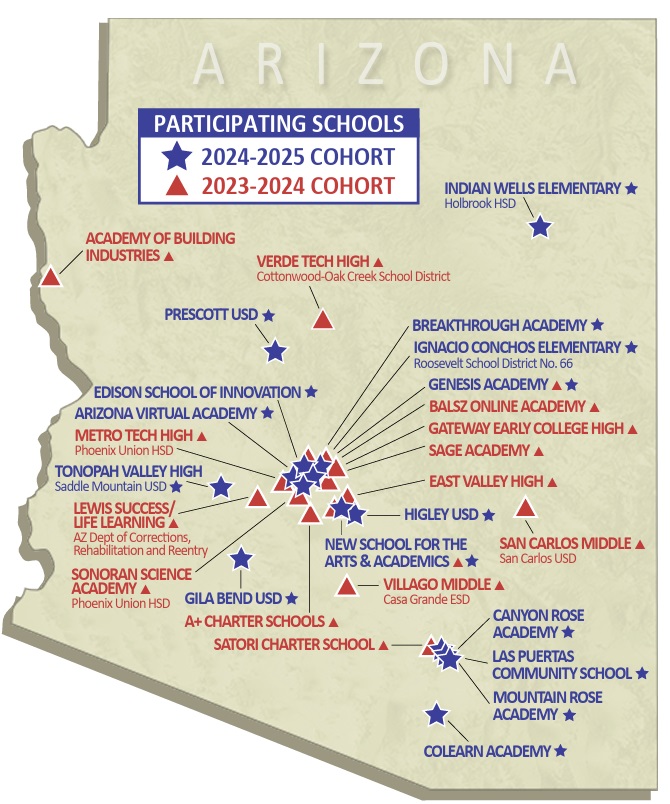
2025-2026 CCC Map

College & Career Competencies Project Cohorts

2022-2023 2023-2024 2024-2025
Carl Hayden Community High School A+ Charter Schools Indian Wells Elementary
Navajo County Instruction for Success High School (NCIS) Academy of Building Industries Prescott USD
Tucson Success/Life Learning Balsz Online Academy Edison School of Innovation
San Luis High School East Valley High School Arizona Virtual Academy
Girls Leadership Academy of Arizona Gateway Early College High School Tonopah Valley High
AmeriSchools Academy (Yuma Campuses) Genesis City Gila Bend USD
Franklin Phonetic Primary School  Lewis Success/Life Learning New School for the Arts & Academics
Center for Academic Success (Douglas Campus) New School for the Arts & Academics Higley USD
Camelback Academy Metro Tech High School Genesis Academy
Ganado Middle School Sonoran Science Academy Phoenix K-12  Ignacio Conchos Elementary
Ganado High School Sage Academy Breakthrough Academy
Desert Heights Preparatory Academy Satori Charter School Canyon Rose Academy
San Carlos Middle School San Carlos Middle School  Las Puertas Community Schools
Riverview High School Verde Tech High School  Mountain Rose Academy
Winslow Success/Life Learning   Colearn Academy
Cibola High School    
Fort Mohave Elementary     
Camp Mohave Elementary    

 Informational Resources

Learn more about the College & Career Competencies Project by watching these videos


Contact Us

For general questions or more information, please email Lauren Friend.

Page revised 5/14/24

Restraint and Seclusion

Restraint and Seclusion

Discipline of Students with Disabilities

Dear Colleague Letter, US DOE/Office of Special Education Programs (OSEP), 2022.
OSEP implores districts to examine their policies, practices, and procedures to address discipline disparities that result in students with disabilities being subjected to higher rates of aversive practices, suspensions, and expulsions. OSEP urges districts to advise educators and administrators to use strategies other than exclusionary discipline to provide FAPE.

Q & A on Addressing the Needs of Children with Disabilities and IDEA’s Discipline Provisions, US DOE/Office of Special Education and Rehabilitative Services (OSERS), 2022.
Citing confusion about how to apply discipline to students with disabilities in compliance with the IDEA, OSERS answers 70 questions on discipline. OSERS explains that the misapplication of disciplinary protections, or the failure to apply them, may result in disparate exclusion of students of color.

Positive, Proactive Approaches to Supporting Children with Disabilities: A Guide for Stakeholders, OSERS, 2022.
Districts must reconsider their use of exclusionary discipline and aversive practices. Exclusionary discipline is not appropriate for nonviolent offenses like tardiness, absenteeism, or subjective offenses such as defiance or disrespect. Instead, OSERS urges districts to implement culturally and linguistically responsive measures to create a positive school environment.

Restraint and Seclusion

The US Department of Education released these publications that outline principles for educators, parents, and other stakeholders to consider when developing or refining policies and procedures to support positive behavioral interventions and to avoid the use of restraint and seclusion.

Page revised 9/15/22

Key Definitions

Key Definitions

In any conversation it is important that the parties share a common vocabulary. Sometimes the common terms used in special education are misunderstood. Below are some commonly used special education terms with their accompanying definitions to help ensure effective communication.

Accommodations

According to Arizona State Board of Education rules, “accommodations means the provisions made to allow a student to access the general education curriculum and demonstrate learning. Accommodations do not substantially change the instructional level, content or performance criteria, but are made in order to provide a student equal access to learning and equal opportunity to demonstrate what is known. Accommodations shall not alter the content of the curriculum or a test, or provide inappropriate assistance to the student within the context of the test.” [A.A.C. R7-2-401(B)(1)]

The IDEA and its implementing regulations obligate schools to make a free appropriate public education (FAPE) available to students with disabilities, which means that the eligible student is entitled to special education and related services that are provided in conformity with an IEP. [20 U.S.C. § 1401(9); 34 C.F.R. § 300.17(d)] While the IDEA regulations under 34 C.F.R. § 300.320(a)(6)(i) only require individual accommodations within the content of an IEP when necessary to measure a student’s performance on state and district-wide assessments, the United States Department of Education/Office of Special Education Programs (OSEP) has offered pertinent policy guidance with regards to accommodations. “[F]or students found eligible for services under the IDEA, any accommodations deemed necessary for the student to receive a [FAPE] must be included on the child’s [IEP].” [Letter to Wilson, 43 IDLER 165 (OSEP 2004)]

Accommodations ensure equal access. When a student eligible for special education takes a general education class, has the same grading standard as non-disabled peers, and passes the class with accommodations, the student receives a regular graduation credit.

Assist vs. Provide

The regulations that implement the IDEA state that “paraprofessionals and assistants who are appropriately trained and supervised” can be used “to assist in the provision of special education and related services under [the IDEA] to children with disabilities.” [34 C.F.R. § 300.156(b)(2)(iii)] The crux of the matter is the meaning of the word assist. The United States Department of Education/Office of Special Education Programs (OSEP) explains that “this provision should not be construed to permit or encourage the use of paraprofessionals as a replacement for teachers or related service providers who meet State qualification standards.” [Analysis of Comments and Changes, Subpart B – State Eligibility, Federal Register, Vol. 71, No. 156, p. 46612 (August 14, 2006)] Clearly, this means that any assistant cannot be solely responsible for the provision of special education instruction and services, cannot be used as a replacement for a special education teacher, cannot be directly responsible for providing special education instruction and services, and any provision of special education can occur only under the supervision of special education personnel. [Id.]

The question then to be answered is when does assistance cross the line from assisting in the provision of special education to providing special education and related services? Although the specific language of the IDEA does not directly answer this question, OSEP again provides some guidance in this regard: “The [IDEA] makes clear that the use of paraprofessionals and assistants who are appropriately trained and supervised must be contingent on State law, regulation, and written policy giving States the option of determining whether paraprofessionals and assistants can be used to assist in the provision of special education and related services under Part B of the Act, and, if so, to what extent their use would be permissible. However, it is critical that States that use paraprofessionals and assistants to assist in providing special education and related services to children with disabilities do so in a manner that is consistent with the rights of children with disabilities to [a] FAPE under Part B of the Act.” [Id.]

Evaluation vs. Assessment

Although the terms assessment and evaluation are often used interchangeably, they have different meanings. Evaluation is a process that begins with a review of existing data and ends with a determination of eligibility. [See 34 C.F.R. § 300.305(a) and A.A.C. R7-2-401(E)(3)] Evaluation is defined in the IDEA regulations as procedures that are used to determine whether a student has a disability and, if so, the nature and extent of his/her need for special education and related services. [34 C.F.R. § 300.15] The Commentary to the IDEA regulations echoes this by stating that an evaluation under the IDEA refers to the process for determining eligibility for special education and related services. [34 C.F.R. Part 300, Analysis of Comments and Changes, Subpart D–Evaluation, Eligibility, IEP, Educational Placement, Federal Register, Vol.71, No. 156, p. 46639 (August 2006)] Additionally, the IDEA regulations specify that evaluations may, among other things, be used to determine whether additions or modifications to a child’s special education and related services are needed. [34 C.F.R. § 300.305(a)(2)(iv)]

Assessment focuses on teaching and learning, and provides information for improving learning and instruction. Assessment information is used by teachers to make changes to the educational environment, and assessment is shared with students to help them improve their learning.

An example regarding independent educational evaluations (IEEs) points out the difference between what might be considered an evaluation and what might be considered an assessment by analogy. The purpose of the appraisal performed becomes critical in determining whether parents are entitled to an independent educational evaluation (IEE) when they disagree with the results of that appraisal. If the purpose of the appraisal is to determine the presence or absence of a disability or to evaluate the nature or extent of a student’s need for special education and related services, it's considered an evaluation and the parent would be entitled to an IEE if they disagreed with the results of that evaluation. If, on the other hand, an appraisal is carried out to inform the present levels of academic achievement and functional performance and/or to develop measurable postsecondary goals in the IEP (and does not result in an evaluation), the parent would not be entitled to an IEE.

Free Appropriate Public Education (FAPE)

“FAPE means special education and related services that are provided at public expense, under public supervision and direction, and without charge; meet the standards of the [State]; include an appropriate preschool, elementary school, or secondary school education; and are provided in conformity with an individualized education program (IEP).” [34 C.F.R. § 300.17]

FAPE Standard Clarified

In March 2017 the US Supreme Court, in Endrew F. v. Douglas County School District, clarified the FAPE standard and ruled unanimously that IEPs must be "reasonably calculated to enable a child to make progress in light of the child's circumstances." The Court rejected the petitioner's view that the IDEA requires schools to provide educational opportunities for children with disabilities that are "substantially equal to the opportunities afforded [to] children without disabilities." However, the Court also rejected the view that schools, in order to meet their obligations under the IDEA, only have to provide "merely more than de minimis" education program to a student with a disability. The Court ruled that the "de minimis" test is not demanding enough, and said cogently that "[i]t cannot be right that the IDEA generally contemplates grade-level advancement for children with disabilities who are fully integrated in the regular classroom, but is satisfied with barely more than de minimis progress for children who are not."

Frequency vs. Duration

Among other things, each child’s IEP must include “a statement of the special education and related services and supplementary aids and services … that will be provided to enable the child to advance appropriately toward attaining the annual goals, and to be involved in and make progress in the general education curriculum, and the projected date for the beginning of the services, and the anticipated frequency, location, and duration of those services. [34 C.F.R. § 300.320(a)(4) and (7)] To meet the requirement above that an IEP must include information on the frequency and the duration of a particular service, it is generally understood that frequency refers to how often a student will receive a service (the number of times each week), and duration refers to how long each session will last (the number of minutes/session) and the start and end dates of that service.

There is no requirement that the amount of services cannot vary from week to week if necessary, and there is nothing in the regulations that would bar such an arrangement; however, if the services are less than daily or weekly, then the IEP must specifically and clearly provide an explanation. [See Letter to Matthews, 55 IDELR 142 (United States Department of Education/Office of Special Education Programs (OSEP) 2010)] Although the exact number of minutes of a special education service to be provided to a student does not have to be included in the IEP, the amount of services must be reasonably known to all parties involved in the development and implementation of the IEP. [JL v. Mercer Island School District. F 3d, 109 IDELR 48649 (9th Cir. 2009)] To this end, the amount of time for each service must be stated in the IEP with sufficient clarity to be understood by all persons involved in the development and implementation of the IEP. [Letter to Gregory, 17 IDELR 1180 (OSEP 1991)]

IDEA—Purpose and Outcomes

The purpose of the IDEA is “to ensure that all children with disabilities have available to them a free appropriate public education (FAPE) that emphasizes special education and related services designed to meet their unique needs and prepare them for further education, employment, and independent living.” [34 C.F.R. § 300.1(a)]

The regulations that implement the IDEA state that “the primary focus of the State’s monitoring activities must be on improving educational results and functional outcomes for all children with disabilities,” and also on ensuring that schools meet IDEA requirements, “with a particular emphasis on those requirements that are most closely related to improving educational results for children with disabilities.” [34 C.F.R. § 300.600(b)]

Least Restrictive Environment (LRE)

The Individuals with Disabilities Education Act (IDEA) requires schools to place students in the least restrictive environment (LRE). LRE means that, to the maximum extent appropriate, schools must educate students with disabilities in the regular classroom with appropriate aids and supports, referred to as “supplementary aids and services,” along with their nondisabled peers; the placement should be in the school they would attend if not disabled, unless a student’s individualized education program (IEP) requires some other arrangement. This requires an individualized inquiry into the unique educational needs of each student with a disability in determining the possible range of aids and supports that are needed to facilitate the student’s placement in the regular educational environment before considering a more restrictive placement. [U.S. Department of Education, OSEP Memorandum 95-9 (November 23, 1994)]

Although there is a strong preference for educating a child in the regular classroom, this may not always be the LRE. For example, a student with a hearing impairment who communicates only with sign language may be unable to communicate easily or directly with hearing peers in the general education classroom/environment. In this case, a more restrictive environment on the continuum of possible placements, say a placement at a special school for the deaf, may actually be the LRE for this child.

Modifications

“Modifications means substantial changes in what a student is expected to learn and to demonstrate. Changes may be made in the instructional level, the content or the performance criteria. Such changes are made to provide a student with meaningful and productive learning experiences, environments, and assessments based on individual needs and abilities.” [A.A.C. R7-2-401(B)(13)] Modifications lower the performance standards and provide access to a simplified curriculum.

Placement vs. Location

Placement decisions must be made by a group of persons, including the parents, and others knowledgeable about the child who understand the meaning of evaluation data and the placement options, and must base their decisions on the child’s IEP. [34 C.F.R. § 300.116] The IDEA regulations state that schools “must ensure that a continuum of alternative placements is available to meet the needs of children with disabilities for special education and related services.” [34 C.F.R. § 300.115(a)] This continuum must include “instruction in regular classes, special classes, special schools, home instruction, and instruction in hospitals and institutions.” [Id. at subsection (b)(1)] Schools are required to “make provision for supplementary services (such as resource room or itinerant instruction) to be provided in conjunction with regular class placement.” [Id. at subsection (b)(2)]

The Commentary to the IDEA regulations explains: “Historically, we have referred to ‘placement’ as points along the continuum of placement options available for a child with a disability, and ‘location’ as the physical surrounding, such as the classroom, in which a child with a disability receives special education and related services. [34 C.F.R. Part 300, Analysis of Comments and Changes, Subpart B–State Eligibility, Federal Register, Vol.71, No. 156, p. 46588 (August 2006)]

“A public agency may have two or more equally appropriate locations that meet the child’s special education and related services needs and school administrators should have the flexibility to assign the child to a particular school or classroom, provided that determination is consistent with the decision of the group determining placement.” [Id.] Therefore, a placement decision is not the determination of a particular classroom within a school or the identification of a particular teacher or school personnel who will be providing services to the child. The United States Department of Education Office of Special Education Programs (OSEP) provides guidance in this regard by explaining that schools are permitted to make determinations about specific classrooms, teachers and support personnel as a matter of administrative concern and prerogative. [Letter to Wessels, 16 IDELR 735 (16 EHLR 735)(OSEP 1990)]

Specially Designed Instruction

The IDEA regulations define special education as “specially designed instruction, at no cost to parents, to meet the unique needs of a child with a disability.” [34 C.F.R. § 300.39(a)(1)] The regulation continues: “[s]pecially designed instruction means adapting, as appropriate to the needs of the eligible child . . . the content, methodology, or delivery of instruction.” Special education also means “the adjustment of the environmental factors, modification of the course of study and adaptation of teaching methods, materials and techniques to provide educationally for those children who are gifted or disabled to such an extent that they need specially designed instruction in order to receive educational benefit.” [A.R.S. § 15-761(31)]

Specially designed instruction, which by definition has to be different from the instruction provided to children without disabilities, does not equate with simply providing accommodations and academic support (assisting students with assignments). Specially designed instruction is a specialized type of instruction that cannot be accomplished by a child’s mere attendance in a special education resource classroom. The United States Department of Education/Office of Special Education Programs (OSEP) “recognizes that classrooms across the country are changing as the field of special education responds to innovative practices and increasingly flexible methods of teaching. [However], [w]hile the needs of many learners can be met using such methods [best teaching practices or services that are part of a school’s regular education program], they do not replace the need of a child with a disability for unique, individualized instruction that responds to his or her disability and enables the child to meet the educational standards within the jurisdiction of the public agency that apply to all children.” [Letter to Chambers, 59 IDELR 170 (OSEP 2012)]
IEP Practical Suggestions

IEP Practical Suggestions

The suggestions below are practical advice, not requirements. ESS and Dispute Resolution staff have collaborated to share their ideas about how to develop, nurture and maintain good relationships with parents, how to make the IEP process smoother and more understandable, and how to help build a culture of ongoing compliance along the way.

Scheduling Meetings

Make it a habit to schedule IEP and MET meetings well in advance of the IEP anniversary date or the 60-day evaluation or reevaluation deadline. Then there will be sufficient time if the parents ask to reschedule or if unanticipated events require the meeting date to be changed.

IEP Meeting - Parental Participation

Parents are usually outnumbered at IEP meetings and can feel that the IEP process is not collaborative but adversarial.

Suggestion: Use round tables when possible. Have school personnel wait outside the room or remain standing in the meeting room until the parents arrive so that everyone either enters the room or sits at the same time.

IEP - Draft Copy

If the school creates a draft IEP as a proposal for the IEP team to discuss, then a copy of the draft IEP should be provided to the student's parents in advance so that they can review it at their own pace and process the information; this extra time will enable parents to meaningfully participate in the IEP meeting. The draft IEP should be clearly marked as a draft to avoid any appearance of predetermination on the part of the school.

IEP Meeting - Use of Names

Starting off an IEP meeting with introductions helps everyone be more comfortable and sets a positive tone.

Suggestion: Ask parents how they want to be addressed and then follow their requests.

IEP Meeting – Know Your Role

At the start of IEP meetings, the participants typically introduce themselves in the following ways: I am Mary Smith, the general education teacher; or I am Bill Jones, the special education teacher. However, it is far more important for the parties to understand each person’s role.

Suggestion: Have each participant explain his/her role. Example: I am Mary Smith and I teach second grade. My role in this meeting is to answer questions and provide input about grade-level curriculum and grade-level standards. Because I am in the classroom with second graders on a daily basis, I am aware of different learning styles, strategies and behaviors typically seen in a second grade classroom. I know how typical second graders learn and the misunderstandings and pitfalls that they often encounter. As your child's general education teacher, I can also provide information on your child's progress and interactions with others. I am here today to help this IEP team as it considers information and makes decisions.

IEP Meeting – Start With the End in Mind

Often an IEP meeting begins with a review of the old IEP and any progress made, followed by a discussion of the student’s needs, his/her proposed goals, the services to be made available, and then placement. Very little time is devoted to the ultimate goal of what happens to the student after graduation.

Suggestion: Start the IEP meeting with the focus on the future and how current progress and proposals will help move the student to the desired outcome. Begin the conversation on a positive note by sharing a student's strengths, accomplishments and progress.

IEP Meeting - Student Role

Suggestion: If the student is going to be a participant in the meeting, consider adopting a student-led IEP meeting. While working toward this goal, a school can assign the student a preparatory role: have the student introduce the participants; explain what his or her disability is; explain what accommodations are helpful and necessary to his/her success; outline future goals.

IEP Meeting - Train the Agency Representative

It is not uncommon that IEP team participants do not understand the role of the agency representative. Because this required IEP team member understands the overall curriculum, provides or supervises the delivery of special education, and can commit resources, the agency representative is the person ultimately responsible for making decisions if consensus does not occur, either between the parents and the school or between staff members.

Suggestion: Train the staff who will serve as agency representatives at IEP meetings so that they fully understand their role and responsibility.

IEP Process – It’s Not Jumping Through Hoops

When reduced to basics, the IEP is a communication tool used so that everyone understands what is expected will happen. School personnel often fall into noncompliance because they view the regulatory requirements as administrative hoops to jump through rather than important steps to follow to ensure clear communication and a shared understanding. When school personnel view the regulations as an impediment or a bureaucratic imperative only, the result is often a frayed relationship with parents and noncompliance can result.

Suggestion: Learn and understand the regulations and how they can affect the outcomes of a student's school experience. Remind and instill in your staff that there is a purpose behind the regulations and that they are not an end in themselves. The regulations exist to guide schools so that there is a common and shared understanding of the student’s present levels, his/her educational needs, the goals, the services to be made available, and the student’s ongoing progress.

PWN - Timing

Although the term prior written notice sometimes leads people to believe it is a document provided before a meeting, similar to a meeting notice, it is to be provided after a decision is made but before it is implemented.

Suggestion: Be mindful when assigning the implementation date for a service. Make sure the PWN is provided to the parents after the decision is made but prior to its implementation.

PWN – Include the Date

Often the prior written notice (PWN) form will have a date at the top when it is provided to the parent, but the date of the decision referenced in the PWN is often not included, leading to possible confusion.

Suggestion: Include in the wording of the PWN the date of the meeting when the decision to propose or refuse the action actually occurred, as the date when the PWN was written is not always the same as the date of the meeting when the decision took place.

PWN - It’s More Than Checking Off the Boxes

Although the use of PWN templates, drop-down menus and check-off boxes on PWNs is not prohibited by the regulations that implement the IDEA, the sole reliance on these can lead to misunderstandings and can damage relationships with parents. Often a PWN will only say that the school proposes to implement an IEP. This is problematic when the decision was to stop providing paraprofessional support, reduce speech services from 60 minutes/week to 30 minutes/month, or to remove accommodations.

Suggestion: If your school uses drop-down menus or PWN templates, supplement the information with specific details to ensure that the school is clearly communicating with parents, particularly when a service is added, removed or changed.

PWN – Avoid Nonsense Phrases

Often a prior written notice (PWN) will state that the school considered but then rejected not having an IEP meeting, not considering a parent’s suggestion, or not conducting the required three-year evaluation process. The PWN will then go on to state that such notions were rejected because these are required steps. It makes the school look silly to suggest that it seriously considered rejecting a requirement.

Suggestion: Take time when constructing a PWN so that it is clear and that all statements actually make sense and incorporate the actual thinking of the parties and any decisions that were made.

Accommodations – Document Any Limitations

Often an IEP will list an accommodation without explaining whether or not there will be any limitation on that accommodation. Is that accommodation needed all day in all of a student’s classes or subject areas? Is that accommodation needed in all activities, or only in some?

Suggestion: The IEP team should have a careful discussion about accommodations at every IEP meeting, and the IEP should include sufficient explanation of any limitation for an accommodation, for without an explanation of limitation, the expectation is that the accommodation is made available all the time in every circumstance.

Accommodations – Review Them Carefully

It is not uncommon that at an annual IEP review there will be only a short time devoted to accommodations, and typically all accommodations are rolled over from the old to the new IEP without discussion. The discussion of accommodations should be a thoughtful process, not an automatic one. One purpose of the IDEA is to move students with disabilities to independence, and simply rolling over accommodations year after year can result in learned helplessness and dependence.

Suggestion: Part of any discussion of accommodations should be about whether or not the student continues to need an accommodation and if it is time to try to wean the student off that accommodation. If the team decides the time is right to wean a student off an accommodation, the IEP and PWN should reflect how, when and for how long the experiment will last, and the documentation should include how data will be collected, who will gather the data, and when and how the IEP team will receive and review that information.

Accommodations – Avoid Laundry List Mentality

Often an IEP team will add accommodation after accommodation because the team thinks the more, the better, or that additional accommodations would be nice. Accommodations should be carefully considered, and only those accommodations that are necessary to ensure equal access should be added to an IEP. If an IEP has dozens of accommodations, it is unlikely that school personnel will remember all of them or ensure that they are made available.

Suggestion: The IEP team should have a careful and deliberate discussion about each proposed accommodation, and only those that are determined necessary to ensure equal access should be included in the finalized IEP.

Modifications – Implications for Graduation Credits

“Modifications means substantial changes in what a student is expected to learn and to demonstrate. Changes may be made in the instructional level, the content or the performance criteria. Such changes are made to provide a student with meaningful and productive learning experiences, environments, and assessments based on individual needs and abilities.” [A.A.C. R7-2-401(B)(13)] If a student passes a general education class but has a lower performance standard and a different grading standard, then the student should not receive a regular graduation credit.

Suggestion: Sufficient time should be taken at IEP meetings to explain how modifications might prevent a student from receiving a graduation credit for that particular class or subject so that everyone understands and so that parents will not be surprised. Make sure that the IEP team has a clear understanding of the differences between accommodations and modifications.

Specially Designed Instruction – IEP Meeting Preparation

It is not uncommon even among special education teachers and administrators that there is a misunderstanding about exactly what special education is. Specially designed instruction is by definition different from the education provided to general education students, and it is not academic support (helping a student with assignments) and providing accommodations. Special education is defined in the federal regulations as specially designed instruction, which means adapting as appropriate to the child, the content, methodology or delivery of instruction. [34 C.F.R. § 300.39(b)(3)]

Suggestion: Train your staff so that they know what specially designed instruction is. Have each special education teacher prepare for each IEP meeting by having him/her write a short paragraph describing the specially designed instruction that will be made available to the student. This information should be shared at the meeting and documented in the IEP.

Specially Designed Instruction – Document in the IEP

It is not uncommon that service times written in the IEP are written according to the bell schedule instead of the needs of the student. For example, if a class period is 55 minutes, then the IEP will often say that the student will have 55 minutes of special education service. It is not the length of a class period or the mere presence of a special education teacher that equates with specially designed instruction. If a student is in a special education resource class for 55 minutes/day, he/she may receive academic support (assistance with assignments or practice and reinforcement) from a paraprofessional or another student for 15 minutes, he/she may work independently for 15 minutes, he/she may be involved in the general curriculum for 15 minutes, and may receive specially designed instruction for only 10 minutes.

Suggestion: Carefully and clearly document in the IEP the anticipated amount of time the student will actually receive specially designed instruction, not just the amount of time he/she is in a special education environment. The information on the IEP service page and in the LRE statement should make clear the anticipated amount of specially designed instruction the student will receive and also lay out the anticipated breakdown of time the student will be in a special education environment and how that time will be devoted.