Path
hns
Contact
Contact name or title
Health & Nutrition Services
Contact phone number
(602) 542-8700

Program Forms and Resources CACFP

Program Forms and Resources CACFP

The following are program forms and resources for operators of the Child and Adult Care Food Program.

 Organizational

Administrative Forms:

Adding a Site:

  • Add/Change/Delete Form
    • HelpDesk Add/Change/Delete
      • Log into ADEConnect
      • Click 'Help'
      • Click 'HelpDesk'
      • Click 'New Request'
      • Locate Health and Nutrition Services templates
      • Select 'HNS Add/Change/Delete form'
      • Complete all required fields and applicable optional fields within HelpDesk's Add/Change/Delete form
      • *Use/Requestor submitting Add/Change/Delete form must be submitted by an Authorized Signer listed on the Food Permanent Service Agreement
    • Manual (print, sign, scan, and email to the specialist)
  • Child Care Standards for Unlicensed Facilities

Household Contact Procedure:

 Required Postings

 Participant Enrollment and Eligibility

Child Care Center Enrollment:

Adult Care Center Enrollment:

 Counting and Claiming

Counting and Totaling Meals Served:

Tracking Program Expenses:

Submitting a Claim:

Program Calculators:

Training for the Child and Adult Care Food Program

Training for the Child and Adult Care Food Program


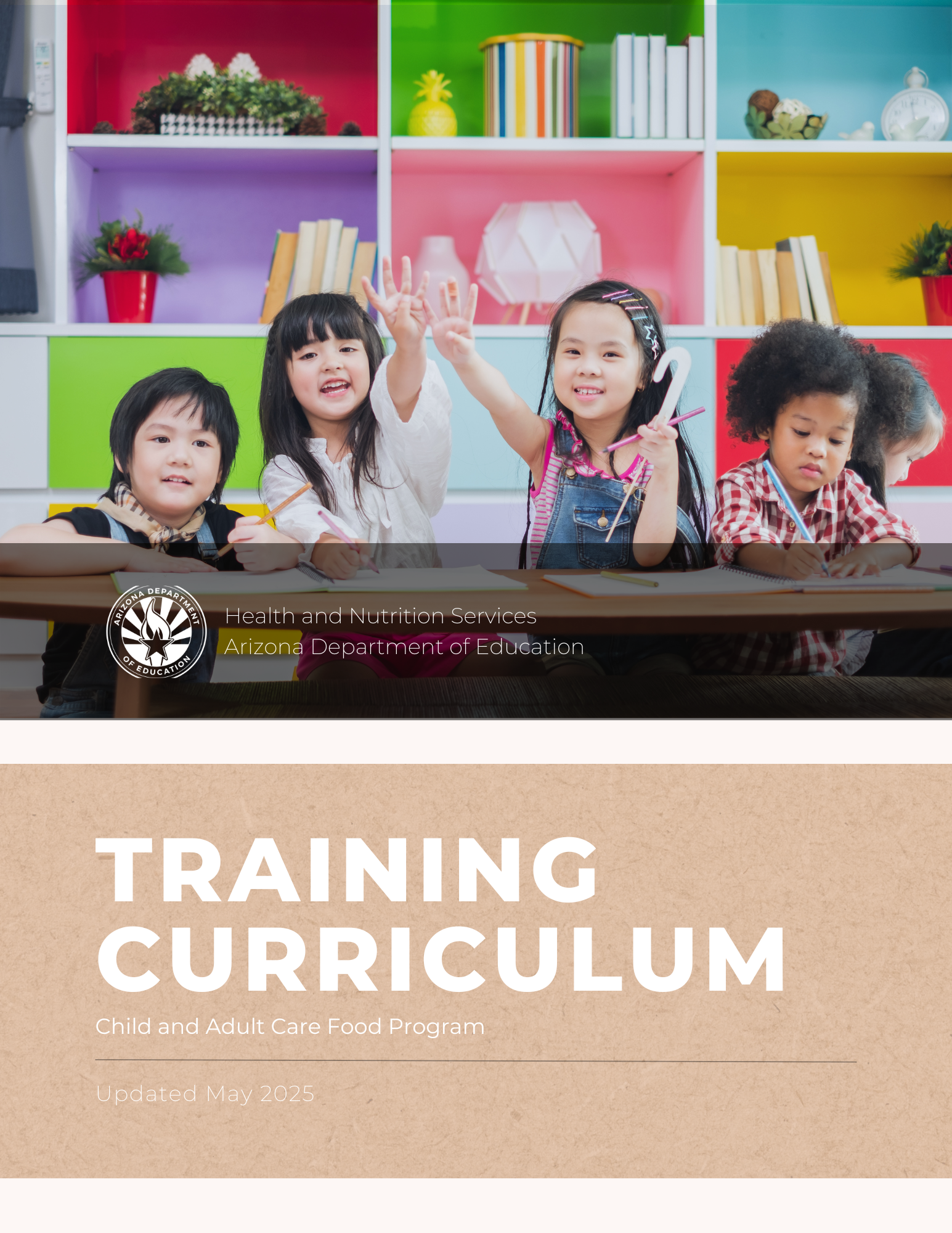
CACFP Training Curriculum.png


The Health and Nutrition Services (HNS) is proud to offer online training opportunities for operators of the CACFP. On this webpage, you will find trainings created by HNS and system partners that will expand program knowledge and support thriving CACFP operations.

Annual Training Requirements for CACFP Sponsors

Operators are required to complete CACFP and Civil Rights training annually. HNS offers many training options for organizations to complete throughout the fiscal year. All trainings available to contribute to the new training requirements are listed on this webpage and announced monthly in the HNS Events Forecast. 

Please note, there are some instances in which ADE HNS will require the completion of a specific training. In the event that a training is mandatory, the requirement will be announced formally in an HNS memorandum.

Training Plan: This training plan is an optional resource for institutions to plan and track the process towards the training requirements. Operators are responsible for ensuring completion of any training(s) made mandatory by ADE HNS. 

Training Requirements for Renewing Applicants:

  • CACFP Training
    • Complete at least 10 Training Hours
    • Complete at least one Nutrition and at least one Administration training
    • Every person on the Permanent Agreement must complete at least one training
  • Civil Rights Compliance for Child Nutrition Program Operators
    • In addition to the CACFP training, all institutions are required to complete the annual civil rights training. Completion of the civil rights training does not count toward the 10 hours of CACFP training. 

 Build Your Employee Training Plans

ADE is here to help you fulfill your training needs to successfully operate your programs and to help you and your staff obtain the annual training hours required. Because the trainings offered are vast in quantity and diverse in content, ADE has drafted specialized curricula based on job duties to help customers get started creating training plans for the year. Each curriculum provides suggested training relevant to a specific role. Please note that the trainings are suggested but not required.

Required Civil Rights Compliance Training

To access the complete collection of Civil Rights trainings, please visit HNS' Civil Rights webpage.

Administration Virtual Trainings

Administration Trainings Training Title and Link Training Length
Online Course Orientation to the Child and Adult Care Food Program 1.5 Hours
Administration Essentials Series Participant Enrollment 1.0 Hour
Meal Count Summary 0.5 Hour
Training Requirements 0.25 Hour
CACFP Procurement Basics 1.5 Hours
Recordkeeping Requirements and Cost Reporting 1 Hour
Monitoring Requirements for Multi-Site Sponsors 0.25 Hour
What to Expect Series What to Expect: CACFP Administrative Review 0.5 Hour
How-to Guide How to Submit CNPWeb Applications for the Child and Adult Care Food Program 0.5 Hour
How-to Guide How to Submit a Claim in CNPWeb for the Child and Adult Care Food Program 0.75 Hour
How-to Guide How to Navigate Menu Modifications 1 Hour
Webinar Staying on Track with the Essentials of the CACFP for Program Year 2026 (Recording) (Slides) (Q&A) 1 Hour
Webinar Understanding CACFP Monitoring Requirements and the Five-Day Reconciliation (Recording) (Slides) (Q&A) 1 Hour


Nutrition Virtual Trainings

Nutrition Trainings Training Title and Link Training Length
Nutrition Essentials Series Introduction to the CACFP Meal Pattern and Creditable Foods 1 Hour
Menu and Supporting Documentation 0.5 Hour
Meal Service and Food Safety Requirements for the CACFP 0.5 Hour
Infant Feeding Essentials Series Infant Feeding Requirements for the CACFP 0.5 Hour
How to Feed Infants Breastmilk and Formula 0.75 Hour
How to Feed Infants Solid Foods 1 Hour
Quick Guide Menu Supporting Documentation N/A

Featured ICN Trainings

(Free ICN account required)

CACFP Optional Best Practices 1 Hour
Serving Nutritious Foods in Child Care 2 Hours
Featured Empower Training Creating a Breastfeeding-Friendly Child Care Environment [English] [Spanish] 1 Hour
Featured Team Nutrition Trainings Feeding Infants: 0-5 Months 0.5 Hour
How to Support Breastfeeding in the CACFP 0.5 Hour
Feeding Infants: Starting with Solids 0.5 Hour
Crediting Store-Bought Combination Baby Foods in the CACFP 0.5 Hour
Mealtimes with Toddlers 0.5 Hour
Meal Planning for the CACFP 0.5 Hour
Methods for Healthy Cooking 0.5 Hour
Offer Versus Serve in the CACFP 0.5 Hour
Breakfast Basics 0.5 Hour
Serving Adult Participants in the CACFP 0.5 Hour
Using the Nutrition Facts Label in the CACFP 0.5 Hour
Serving Milk in the CACFP 0.5 Hour
Serving Vegetables in the CACFP 0.5 Hour
Serving Meat and Meat Alternatives at Breakfast 0.5 Hour
Using the WIC Food List to Identify Creditable Foods in the CACFP 0.5 Hour
Identifying Whole Grain-Rich Foods for the CACFP Using the Ingredient List, Part 1 0.5 Hour
Identifying Whole Grain-Rich Foods in the CACFP, Part 2 0.5 Hour
In-Grained: Easy Tools to Determine Serving Amounts 0.5 Hour
Crediting Single-Serving Packages of Grains in the CACFP 0.5 Hour
Grain-Based Desserts in the CACFP 0.5 Hour
Grains Ounce Equivalents Tools for CACFP Operators 0.5 Hour
Adding Whole Grains to Your CACFP Menu 0.5 Hour
Webinars Crediting Grains in the CACFP Using Oz Eq (Slides) (Recording) 1 Hour


Family Day Care Homes

Family Day Care Homes

The Child and Adult Care Food Program, CACFP, is a United States Department of Agriculture (USDA) meal reimbursement program helping Family Day Care Homes (FDCHs) provide well-balanced, healthy, and nutritious meals and snacks to children in private home settings. CACFP’s role is critical in creating more affordable options for low-income Arizona families.

Non-profit organizations, including Military or Tribal, with an agreement with the Arizona Department of Education, may serve as a day care home sponsoring organization for the Child and Adult Care Food Program. Licensed or providers approved to provide care who offer organized nonresidential childcare for children, generally 12 years of age or younger, in a private home, may operate the Child and Adult Care Food Program by entering into an agreement with a sponsoring organization.

Apply to Operate the Child and Adult Care Food Program

Family Day Care Home Sponsoring Organization:

If you are a non-profit organization, including Military or Tribal, interested in becoming a Family Day Care Home Sponsoring Organization, please contact Health and Nutrition Services by calling (602) 542-8700, press 1.

Family Day Care Home Providers:

The following information is for in-home childcare providers interested in applying to operate the Child and Adult Care Food Program.

Step 1: Assess Eligibility and Interest

  • Who is eligible to participate in a Family Day Care Home setting?

Any licensed or certified FDCH providers, including Military and Tribal, that meet local/state health, safety, and sanitation standards may enter into an agreement with an eligible Sponsoring Organization. The provider should offer regularly scheduled, organized enrichment/educational activities to children in a supervised environment.

  • What age of children qualify?

Children ages 12 and under, may participate as well as migrant children 15 and under, and disabled children, as defined in 7 CFR 226.2.

  • Is the CACFP right for me?

The following are basic expectations of providers operating the CACFP. To successfully operate the food program, you must be comfortable with the following:

  • Attend trainings and comply with Federal regulations.
  • Serve meals that meet the CACFP meal pattern
  • Complete and maintain paperwork on a daily, weekly, monthly, and annual basis, including but not limited to sign-in and out sheets, meal participation records, menus, applications, etc.
  • Receive announced or unannounced home visits by auditors, ADE/USDA staff persons, and sponsor monitors.

Step 2: Find a Sponsoring Organization

  • What is a Sponsoring Organization:

A sponsoring organization is a non-profit organization, including the Military or Tribal, that has an agreement with the Arizona Department of Education (ADE) Health and Nutrition Services (HNS) Unit and provides services to FDCH providers.

  • How do I find a Sponsor for my home:

Click here for Family Day Care Home Sponsoring Organizations. ADE recommends you contact and invite several sponsoring organizations to your home to become acquainted and comfortable with them before entering into an agreement. They will explain the rules and requirements, and you will select only one.

  • What are the responsibilities of a Sponsoring Organization:

Sponsors will recruit, monitor, and reimburse the providers and conduct in-service training to FDCHs. This includes assessing compliance of meal pattern requirements, keeping records of procedures, verifying providers’ household income, and determining eligibility of their own children (if in the program) and classifying homes for reimbursement as Tier I or Tier II. They will visit your home at least three times during the year.

Step 3: Work with Sponsoring Organization to Receive Training and Apply for the CACFP

After selecting a sponsoring organization to work with, you will collaborate with your sponsor contact to schedule a time to receive training and apply for the CACFP.

Renew your Participation in the Child and Adult Care Food Program

All Family Day Care Home Sponsoring Organizations are required to renew annually. Each year, you will be contacted by the Arizona Department of Education with specific renewal details, including renewal training requirements.

The following forms and resources are available to assist in the completion of your renewal application. These items will be updated as needed by ADE.

Checklist:

FDCH Sponsor Renewal Application Checklist

FDCH Renewal Application Chart

Forms and Resources for the Management Plan and Budget:

All Family Day Care Home Providers are required to renew their participation in CACFP every two years. Your Family Day Care Home Sponsoring Organization will guide you regarding the specific renewal details, including which forms, licensing requirements, and renewal training requirements.

Reviews Conducted by the State Agency

ADE must conduct compliance reviews of all sponsoring organizations operating the CACFP at least once during each three-year review cycle. The objectives of the compliance reviews are to:

  • Determine whether program requirements are met
  • Provide technical assistance
  • Secure any needed corrective action
  • Assess fiscal action and, when applicable, recover improperly paid funds.

What to Expect: Family Day Care Home Administrative Review

Sponsor Administrative Review Procedures

Guidance Manuals

Federal Regulation:

  • Code of Federal Regulations:
    • 7 CFR Part 226 – Primary regulation governing the Child and Adult Care Food Program.
    • 2 CFR Part 200 – Uniform administrative requirements, cost principles, and audit requirements for Federal programs.
    • 48 CFR Part 31 – Federal Acquisition Regulation (FAR 31) is the primary regulation governing the acquisition of supplies and services with Federal Funds.
  • FNS Instructions:
    • FNS 796-2, Revision 4 – Provides guidance to institutions in developing the financial information needed to comply with requirements of the CACFP.
  • Office of Management and Budget Guidance for Grants and Agreements:
    • 2 CFR Part 225 – Establishes cost principles for State, Local, and Indian Tribal governments.
    • 2 CFR Part 230 – Established cost principles for non-profit organizations.

Find a Sponsoring Organization of the Child and Adult Care Food Program


Resources for Operators

Program Forms and Resources

Training

Reimbursement Rates

Child and Adult Care Food Program

Child and Adult Care Food Program

Child Care Centers

The Child and Adult Care Food Program (CACFP) is a federally funded meal program through the United States Department of Agriculture (USDA) that provides reimbursements for nutritious meals and snacks served to eligible children enrolled for care at participating centers.

A variety of public or private nonprofit child care centers and Head Start programs, which are licensed or approved to provide day care services, participate in CACFP. For-profit centers that serve lower-income children may also be eligible to participate.

Apply to Operate the Child and Adult Care Food Program

If your entity is a Childcare Center and would like to apply to operate the Child and Adult Care Food Program, please review our Child and Adult Care Food Program New Applicant Guide for instructions on the forms required for submission and a detailed guide of the application process. Upon review of the New Applicant Guide, if you would like to apply, please use the following link: 

Renew your Participation in the Child and Adult Care Food Program

Centers operating the CACFP must submit a renewal application annually to continue program participation each program year. Forms and resources available to assist are available on our Renewal Resources webpage.

Reviews Conducted by the State Agency

The Arizona Department of Education conducts Administrative Reviews (ARs) of all sponsoring organizations operating the Child and Adult Care Food Program (CACFP) at least once during each three-year review cycle. The objectives of the AR are to:

  • Determine whether program requirements are met
  • Provide technical assistance
  • Secure any needed corrective action
  • Assess fiscal action and, when applicable, recover improperly paid funds.

Training

Appeal Procedures

Guidance Manuals

Federal Regulation:

  • Code of Federal Regulations:
    • 7 CFR Part 226 – Primary regulation governing the Child and Adult Care Food Program.
    • 2 CFR Part 200 – Uniform administrative requirements, cost principles, and audit requirements for Federal programs.
    • 48 CFR Part 31 – Federal Acquisition Regulation (FAR 31) is the primary regulation governing the acquisition of supplies and services with Federal Funds.
  • FNS Instructions:
    • FNS 796-2, Revision 4 – Guides institutions in developing the financial information needed to comply with the requirements of the CACFP.
  • Office of Management and Budget Guidance for Grants and Agreements:
    • 2 CFR Part 225 – Establishes cost principles for State, Local, and Indian Tribal governments.
    • 2 CFR Part 230 – Established cost principles for non-profit organizations.

General Program Guidance Manuals:

upLIFT in Child Care

The upLIFT webpage is created to learn and get inspired on how and what you feed your participants. We hope you share your successes and ideas to teach your colleagues in Arizona. Together, we can influence positive dietary behaviors in children and adults!

Find a Center Participating in the Child and Adult Care Food Program

Interested in enrolling in a CACFP facility? Please select “CACFP Site Directory” to view a directory of facilities currently operating the CACFP in Arizona.


Resources for Operators

Program Forms and Resources 

Training

Reimbursement Rates

Sign Up For Our Email Updates

Civil Rights

Civil Rights

State agencies and child nutrition sponsoring agencies shall comply with the requirements of Title VI of the Civil Rights Act of 1964, the Americans with Disabilities Act (ADA), Title IX of the Education Amendments of 1972, Section 504 of the Rehabilitation Act of 1973, and the Age Discrimination Act of 1975.

Additionally, recipients are required to notify applicants with disabilities and limited English proficiency (LEP) persons of their right to free language assistance and accommodations and to provide these services upon request. This notification must be clearly stated on recipient websites.

In the operation of the Child Nutrition Programs, no individual in the United States shall solely by reason of race, color, national origin, religion, sex, disability, age, marital status, family/parental status, income derived from a public assistance program, political beliefs, or reprisal or retaliation for prior civil rights activity be excluded from the participation in, denied the benefits of, or be subjected to discrimination under any program or activity receiving Federal financial assistance.

Free language assistance, auxiliary aids, and/or accommodations are available upon request. Please contact 602-542-8700 or email [email protected].


Forms and Resources for Operators


Training


Filing a Complaint

To file a program complaint of discrimination, complete the USDA Program Discrimination Complaint Form, (AD-3027) found online at: How to File a Complaint, and at any USDA office, or write a letter addressed to USDA and provide in the letter all of the information requested in the form. To request a copy of the complaint form, call (866) 632-9992. Submit your completed form or letter to USDA by:

  1. mail:  U.S. Department of Agriculture Office of the Assistant Secretary for Civil Rights
              1400 Independence Avenue, SW
              Washington, D.C. 20250-9410;

  2. fax: (202) 690-7442; or

  3. email: [email protected].

Para presentar una denuncia de discriminación, complete el Formulario de Denuncia de Discriminación del Programa del USDA, (AD-3027) que está disponible en línea en: How to File a Complaint. y en cualquier oficina del USDA, o bien escriba una carta dirigida al USDA e incluya en la carta toda la información solicitada en el formulario. Para solicitar una copia del formulario de denuncia, llame al (866) 632-9992. Haga llegar su formulario lleno o carta al USDA por:

  1. correo:  U.S. Department of Agriculture Office of the Assistant Secretary for Civil Rights
                  1400 Independence Avenue, SW
                  Washington, D.C. 20250-9410;

  2. fax: (202) 690-7442; or

  3. correo electrónico: [email protected].


Nondiscrimination Policy Statement

All USDA Food and Nutrition Programs should include the required nondiscrimination statement on all appropriate FNS and agency publications, posters, and informational materials. The statement can be found below and at: https://www.fns.usda.gov/civil-rights/nds.


The long statement reads as follows:

In accordance with Federal civil rights law and U.S. Department of Agriculture (USDA) civil rights regulations and policies, the USDA, its Agencies, offices, and employees, and institutions participating in or administering USDA programs are prohibited from discriminating based on race, color, national origin, religion, sex, disability, age, marital status, family/parental status, income derived from a public assistance program, political beliefs, or reprisal or retaliation for prior civil rights activity, in any program or activity conducted or funded by USDA (not all bases apply to all programs). Remedies and complaint filing deadlines vary by program or incident.

Persons with disabilities who require alternative means of communication for program information (e.g., Braille, large print, audiotape, American Sign Language, etc.) should contact the State or local Agency that administers the program or contact USDA through the Telecommunications Relay Service at 711 (voice and TTY). Additionally, program information may be made available in languages other than English.

To file a program discrimination complaint, complete the USDA Program Discrimination Complaint Form, AD-3027, found online at How to File a Program Discrimination Complaint and at any USDA office or write a letter addressed to USDA and provide in the letter all of the information requested in the form. To request a copy of the complaint form, call (866) 632-9992. Submit your completed form or letter to USDA by: (1) mail: U.S. Department of Agriculture, Office of the Assistant Secretary for Civil Rights, 1400 Independence Avenue, SW, Mail Stop 9410, Washington, D.C. 20250-9410; (2) fax: (202) 690-7442; or (3) email: [email protected].

USDA is an equal opportunity provider, employer, and lender.


The short statement reads as follows:

This institution is an equal opportunity provider.

The shorter statement may be used if the material is too small to permit the long statement. However, the print size should be no smaller than the text of the document. Examples include letters, memos, notices, menus, internet, public service announcements, television spots, or advertisements, recruitment and outreach correspondence.


Civil Rights Reminders for Child Nutrition Sponsors

  • Provide your Child Nutrition Program (CNP) in a non-discriminatory manner.
  • Offer meals to all CNP participants. 
  • Offer meal substitutions to any participant who discloses a food allergy, intolerance, medical condition, or any major bodily function affected by a food item. 
  • Prominently display the "And Justice for All" nondiscrimination poster in 11" by 17" dimensions in areas where participants and potential participants have access.
  • Include the nondiscrimination statement on all printed material and webpages available to the public which mentions USDA, CACFP, NSLP, and/or SFSP.
  • Provide informational materials concerning the availability and nutritional benefits of the CNP's inappropriate translations and use language interpreters as needed.
  • Submit your media release to a media outlet annually.
  • Collect ethnic and racial data annually for all CNPs and each camp session in SFSP.
  • Train staff annually on civil rights and maintain the agenda, sign-in sheet, and training materials.
  • Include assurances in all CNP-related contracts.
  • Develop and implement your Civil Rights Complaint procedures.
  • Maintain a Civil Rights Complaint Log.
  • Make the civil rights complaint forms, civil rights log, and civil rights complaint procedures available to all staff.
  • Refer all civil rights complaints to your assigned HNS specialist promptly.

Racial and Ethnic Categories

The race and ethnic categories for data collection and reporting have been changed to the following:

Ethnic Categories:

Hispanic or Latino A person of Cuban, Mexican, Puerto Rican, South or Central American, or other Spanish culture or origin, regardless of race. The term “Spanish origin” can be used in addition to “Hispanic or Latino.”

Non-Hispanic or Non-Latino A person other than Cuban, Mexican, Puerto Rican, South or Central American, or other Spanish culture or origin, regardless of race.

Racial Categories:

Black or African American A person having origins in any of the black racial groups of Africa. Terms such as “Haitian” can be used in addition to ‘Black or African American.’

Asian A person having origins in any of the original peoples of the Far East, Southeast Asia, or the Indian subcontinent, including, for example, Cambodia, China, India, Japan, Korea, Malaysia, Pakistan, the Philippine Islands, Thailand, and Vietnam.

American Indian or Alaskan Native A person having origins in any of the original peoples of North and South America (including Central America), and who maintains tribal affiliation or community attachment.

Native Hawaiian or Other Pacific Islander A person having origins in any of the original peoples of Hawaii, Guam, Samoa, or other Pacific Islands.

White A person having origins in any of the original peoples of Europe, the Middle East, or North Africa.

Administrative Review Summaries

Administrative Review Summaries

Administrative Review Reports

Administrative Review Summary Reports for SFAs Reviewed in Program Year 2026 (PY26) (School Year 2025-2026)


Administrative Review Summary Reports for SFAs Reviewed in Program Year 2025 (PY25) (School Year 2024-2025)

National School Lunch Program and School Breakfast Program - Program Forms and Resources

National School Lunch Program and School Breakfast Program - Program Forms and Resources


Eligibility Documents for School Meal Benefits

REMINDER: Per USDA, the Program Forms should be distributed on or around the beginning of the school year. *Forms cannot be distributed before July 1.

Application Packet

Parent Letters for Special Provision Options

Parent Letters for the Special Milk Program

  • Parent Letter collects applications and charges (English) (Spanish)
    • *Use the instructions and the household application for free and reduced-price meals posted above.
  • Parent Letter: does not collect applications and charges (English) (Spanish)
  • Parent Letter: does not collect applications and does not charge (English) (Spanish)

Certification and Benefit Issuance

Verifying Household Applications

Local Wellness Policy

Operational

Organizational

National School Lunch Program and School Breakfast Program

National School Lunch Program and School Breakfast Program

The National School Lunch Program (NSLP) and School Breakfast Program (SBP) are federally assisted meal programs through the United States Department of Agriculture, operating in public and private nonprofit schools and residential childcare institutions. It provides nutritionally balanced, low-cost, or free breakfasts and lunches to children each school day. The USDA Foods Program supports domestic nutrition programs and American agricultural producers through purchases of 100% American-grown and -produced foods for use by schools and institutions participating in the federal programs.

Apply to Operate the National School Lunch and Breakfast Program

If your entity would like to become a School Food Authority for the National School Lunch Program, please review our School Nutrition Programs New Applicant Guide for instructions on the forms required for submission. Upon review of the guidance forms, if you would like to apply, please use the following links: 

Apply to Operate the USDA Foods and DoD Fresh Produce Program

The USDA Foods and the Department of Defense (DoD) Fresh Produce Programs provide nutritious foods for schools to use in their school nutrition programs. For information, please email [email protected].

Apply to Operate the Community Eligibility Provision

Thank you for your interest in the Community Eligibility Provision (CEP). Applications for Program Year 2026/2027 CEP will open on April 15th, 2026, and will close on June 30th, 2026. Please review the CEP Application Guide for all requirements before applying.

Reviews Conducted by the State Agency

Administrative Reviews (ARs)

The Arizona Department of Education conducts administrative reviews (ARs) of all School Food Authorities (SFAs) operating the National School Lunch Program (NSLP) and/or School Breakfast Program (SBP) at least once during each five-year review cycle. The AR consists of an off-site portion where the reviewer will request documents for the SFA to submit and an on-site portion where the reviewer will observe meal service at a select number of sites within the SFA. The reviewer will notify the SFA of the deadline for the off-site portion, the date of the on-site portion, and the sites that will be reviewed. The following programs will also be reviewed, if applicable: Afterschool Care Snack Program, At-Risk Afterschool Meals, Fresh Fruit and Vegetable Program, and Seamless Summer Option of the Summer Food Service Program.

The required Procurement Review will be conducted by a third-party vendor in the same school year as the administrative review.

Review List

Training

Appeal Procedures

Guidance Manuals

ADE Manuals and Handbooks

ADE Toolkits

USDA Manuals and Handbooks

Financial Guidance

Required State Reporting

upLIFT

The upLIFT webpage is created for you, the school nutrition professional, to learn and get inspired in how and what you feed your students. We hope you share your successes and ideas to teach your colleagues in Arizona. Together, we can influence positive dietary behaviors in
students!

School Nutrition Programs Advisory Council (SNPAC)

The School Nutrition Programs Advisory Council (SNPAC) is comprised of dedicated school nutrition professionals who will advise ADE on issues that impact growth, compliance, and nutrition integrity in Arizona school nutrition programs. The SNPAC consists of 10 individuals representing 235 sites in Arizona. The council members were carefully selected to create a diverse and representative sample of LEAs in Arizona. The SNPAC will be meeting monthly in Program Year 2025. SFAs are encouraged to contact the SNPAC member who best represents their LEA with any questions or concerns they would like to bring to the council.


Resources for Operators

         Program Forms and Resources           

                             Training                               

                Reimbursement Rates                  

USDA Foods Administrative Fee Structure

         Sign Up For Our Email Updates           

Welcome to Health & Nutrition Services

Welcome to Health & Nutrition Services

Health & Nutrition Services

The Health and Nutrition Services Division is committed to enhancing the health and well-being of Arizona’s children and adults by providing access to a variety of federally funded programs.

Free language assistance, auxiliary aids, and/or accommodations are available upon request. Please contact 602-542-8700 or email [email protected].

In accordance with federal civil rights law and USDA civil rights regulations and policies, the USDA, its agencies, offices, employees, and institutions participating in or administering USDA programs are prohibited from discriminating based on race, color, national origin, religion, sex, disability, age, marital status, family/parental status, income derived from a public assistance program, political beliefs, or reprisal or retaliation for prior civil rights activity, in any program or activity conducted or funded by USDA (not all bases apply to all programs). Remedies and complaint-filing deadlines vary by program or incident.

Persons with disabilities who require alternative means of communication for program information (e.g., Braille, large print, audiotape, American Sign Language, etc.) should contact the state or local agency that administers the program or contact USDA through the Telecommunications Relay Service at 711 (voice and TTY). Additionally, program information may be made available in languages other than English.

To file a program discrimination complaint, complete the USDA Program Discrimination Complaint Form, AD-3027, found online at How to File a Program Discrimination Complaint and at any USDA office, or write a letter addressed to USDA and provide in the letter all of the information requested in the form. To request a copy of the complaint form, call (866) 632-9992. Submit your completed form or letter to USDA by:

  1. Mail: U.S. Department of Agriculture, Office of the Assistant Secretary for Civil Rights, 1400 Independence Avenue, SW, Mail Stop 9410, Washington, D.C. 20250-9410;
  2. Fax: (202) 690-7442; or
  3. Email: [email protected].

USDA is an equal opportunity provider, employer, and lender.